22Лип2026
Розуміємо права людини Мережа домів прав людини

контакти

Провулок Луговий, 1 Г,
с. Количівка,
Чернігівський район,

Чернігівська область,
Україна 
15563

+38 0462 930-907
+38 0949 881-907

Позначка: russian occupation

Frame 295 (6)
Новини

My son was killed by the Russians

The resident of the village of Priputni in Chernihiv region tells a heartbreaking story of civilians killed by the Russians.

Priputni is a small village in Chernihiv region. The Russian military was first seen here on February 25, 2022, and they stayed in the village until the end of March 2022, causing the most damage as they retreated. As you walk through the village, it’s hard not to notice the visible scars of war: burnt houses, destroyed buildings, and the traces of military vehicles on the asphalt.

But what the naked eye can see is only the tip of the iceberg. To see more, you must be willing to speak and listen.

As we stroll through Priputni, we meet a woman in her fifties, dressed in a blue floral robe and a warm sweatshirt. She wears a headscarf. The woman is returning from her garden, and by her side is a friendly dog with a wolf-like face named Aira. Aira approaches us, and her owner lovingly says, “Don’t bother them, dear, they’re strangers.”

We begin to talk to Mrs. N. (we don’t mention her full name for safety reasons), explaining who we are and where we’re from, and most importantly, what we want to write about. As soon as she hears the word “Russians,” tears start to well up in her eyes.

“My son was killed by the Russians. They shot him…”

That’s when we learn that Mrs. N. had two sons: one was 24 and the other 19 years old. The older one was killed by the Russian military, and he was a civilian. Warning: the following text contains sensitive material.

“He was friends with another guy, well, more like an acquaintance because the guy was much older. But they were close. He had tractors, so my son used to help him with the tractors and everything. Well, they were killed together when they were going to work in Krupychpole. The Russians shot them at the beginning of Krupychpole. They just burned that guy; he was burnt alive, there was nothing left, just charcoal, burnt to the bone… and my son was found with him, at least he still had his body, even though he was badly burnt.”

This is not an isolated case of Russians killing civilians. Unfortunately, among the local residents, there have been seven casualties.

“They went into other people’s houses, checked homes, and where no one lived, where the houses were empty because people had left, they lived there… They took our food. My neighbor lives over there; they took her butter, bread, all the oils, everything they could find, they took it all. Let them take it, I said. But why did they kill people? Like my son, for what? Innocent people. They shot our locals in Krupychpole. A couple was going to a funeral in Vyshnivka, so on their way there, near Verbychky, just as you head to Vyshnivka, they were also shot. And one man went… You see, the house over there already burned down, so he went there to put out the fire, and they killed him near the village council…”

Mrs. N. confesses that there was a time when the residents of Priputni buried their fellow villagers not in the cemetery but near the church. The hard decision was based on simple safety considerations: neither the priest nor the local residents wanted to risk their lives by going to the cemetery.

Mrs. N. also recalls an incident when an elderly woman was blown up by a landmine.

“There was also a woman who blew herself up on a landmine, on the bridge. We told her not to go, not to go at night… but she didn’t listen and went anyway. Well, we heard a big explosion.”

This woman doesn’t complain about life. She agrees to the publication of her story only on the condition of anonymity because she fears that the Russians might return and seek revenge for this truth. She says life goes on somehow, and they neither receive nor expect any help. She says, “Who cares about us here?”

The only thing that truly worries her is that she can’t afford to put up a tombstone for her son; there’s just a simple cross. Friends console her, saying that heaven has accepted him anyway. But it seems that a proper burial of her beloved son means a lot to Mrs. N.

As she talks about what she’s been through, she doesn’t cry. She stays strong. Sometimes, Aira, the mischievous little pup, seems to sense that her owner’s pain is becoming unbearable and that’s when she does something cute and silly: chasing her tail or trying to nibble on our sneakers. And the smile returns to the woman’s face.

And the sun shines brightly, just like it does during Indian summer.

And life goes on in the village of Priputni in Chernihiv region.

The material was prepared by Kristina But as part of the «Truth Through Stories» School.

The project is implemented by the Education Human Rights House (Chernihiv) with the support of the Ministry of Foreign Affairs of the Czech Republic as part of the local transformation project «Ukraine and Ukrainians: Modern Chronicles of the Fighting for Freedom and Democracy».
Frame 295 (5)
Новини

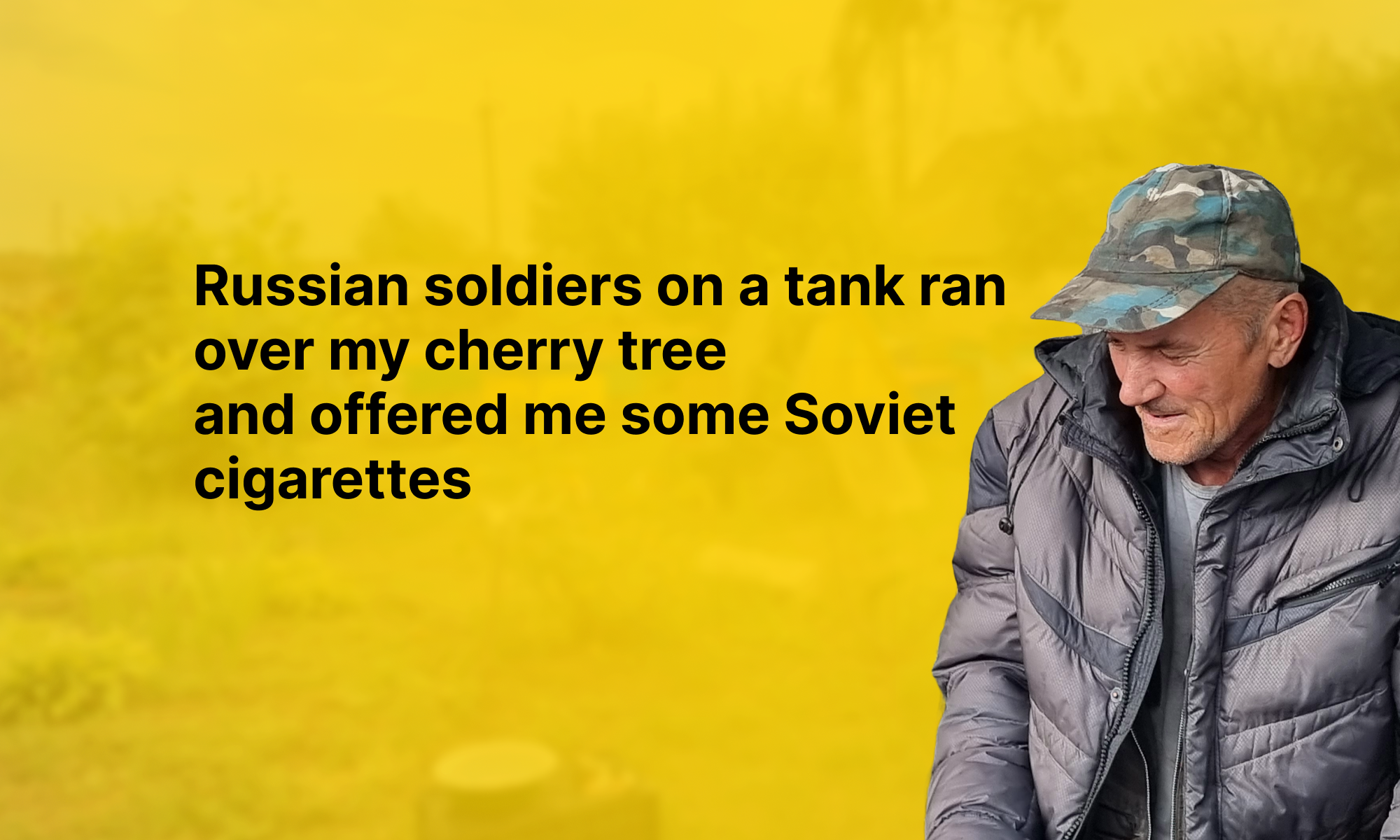
Russian soldiers on a tank ran over my cherry tree and offered me some Soviet cigarettes

M., from Pryputni village (Chernihiv region, Ukraine), shared stories about a bicycle in a puddle of blood, a tank in the yard, and a burning house.

The name has been encrypted for security purposes.

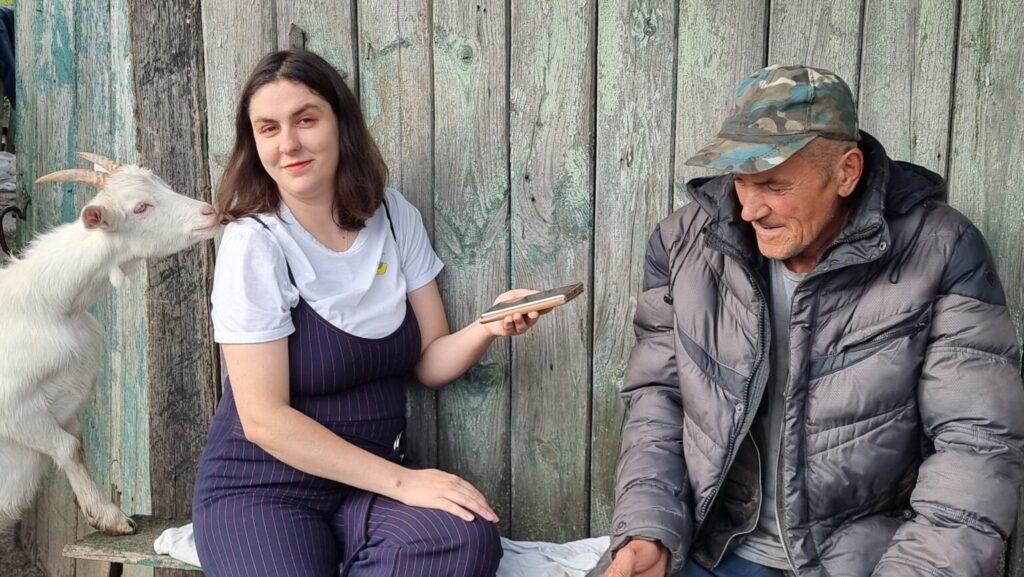
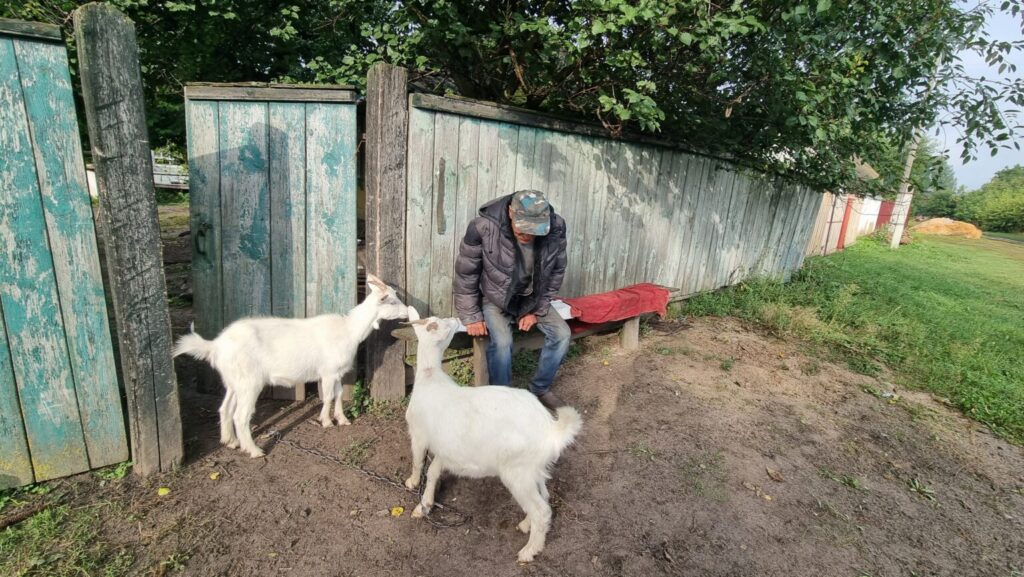
M. greets us near a house, holding towels in his hands. He brought bedding for the bench to make our seating more comfortable.

During our conversation, M.’s pets keep us company. Even the neighbor’s dog lies down near M.’s feet. Goats and cats circle around us, seeking treats and attention.

The man begins to tell his story.

When all of this began, I woke up at 6:00 a.m. on February 24, turned on the TV, and saw Zelensky. I didn’t immediately understand what he was saying. To put it bluntly, I couldn’t make heads or tails of it. So, I thought, ‘What’s he jabbering about?’ I didn’t grasp it at all, so I just went to work.

Sometime after dinner, I saw that all my neighbors went outside. I asked what’s up. They said: M., the war has begun! The war has begun! 

Around 7:00 in the morning, a convoy of vehicles, armored personnel carriers, and tanks arrived. For a month they were just walking back and forth past the village.

I used to work and travel in Russia, I have friends there, so I couldn’t understand, how could they do that? They just kept wandering around for a month, but as soon as they understood they’d have to leave, they made some mess. Chaos, chaos has begun.”

M. tells how he first met Russian soldiers. He was walking home and saw a group of armed men on his street.

“I thought, what should I do? They are russians. I decided to go home. It was springtime, it was still cold, so I thought: I need to warm my house. That’s when I heard them shout: “Owner!”

I went out, and there were seven men with assault rifles.They asked: “Are there any officers here at all?”  I said – what officers? Are you kidding me? There are only about three people living here.

Well, you understood me, right? How could there be any officers? 

That’s it, they left. I just started to light the stove. And then there’s another scream. I went out, there was a Russian with a machine gun. Much younger than me. He asked: “Man, do you smoke?” And we didn’t even have toilet paper. Yeah! And he said: do you smoke? Sure we didn’t have anything to smoke! I said: I smoke, but I don’t have one cig left. And he gave me a pack of “Stewardesses”. I was still a boy when that “Stewardess” was released.” (Old Bulgarian cigarettes, popular in the Soviet Union in the 80’s).

M. laughs sincerely for the first time in the entire conversation.

“Imagine how long it has been in their warehouses. Am I right? Well, I had a chat with him. Simple man, just like me. He said that he was also from a village.

I told him that I used to work in Moscow. He said that he had never visited Moscow. And I said, I said: you know what? That’s funny, cause I’ve been to Moscow many times.

M. says: when the Russians were retreating, he barely escaped death, hiding in a ditch from “a ball of fire, similar to flaming corn.”

And then immediately tells us about the first days of the occupation. 

“And for a long time I didn’t realize that the war had started and the shops were already closed, so I had to go to the neighboring village. I turned back and saw that the Russians were standing right before me. Nowhere to run. And as I kept walking, a Russian soldier saw me. There was a Buryat guy with him, and he spoke to me in Ukrainian.

He said to me “Dobrogo dnya” (“Good day” in Ukrainian.) Well, I responded “Zdrastye”(“Hey”— in Russian) in Putin’s language. 

He reluctantly answers questions about the deaths of local residents.

One day it was like this – I parked my bicycle near the store, and the next day when the convoy had left, I thought I’d go get my bicycle. But when I arrived, there was a puddle of blood next to it. When I asked people about it, they said a fellow villager had been shot. I don’t know why it happened, and no one talks about it.”

I myself had a tank standing in my yard. They broke my cherry tree…

M. does not know what the tank was doing in the yard, but when asked about it, he laughs bitterly. He says he didn’t ask. But he does not regret the event itself – God had mercy, the house survived. Neighbors were less fortunate.

“The neighbors’ house caught fire. We wanted to call the fire brigade. And the driver of the car said: what if they shoot me? We had to manage it ourselves. My neighbor told me – let’s extinguish it, and when the Russians come, you just boo them, wave your hands or something, you know, make them run away. I’m not making it up!

M. did not have the opportunity to evacuate, and he himself had no such plans.

“A Russian once said to me – why didn’t you run away using the green corridor? And how should I know about that corridor? I have no mobile phone, no electricity, no TV, no radio. There was water from the well, that’s all I had. How was I supposed to know?”

While we are talking, M.’s goats are constantly trying to join the conversation. The host quarrels softly. Marysia, a chubby kitty with ginger stripes, constantly tries to climb into the owner’s arms.

“The animals survived everything. I got my goats only when the Russians left. I often think about the neighbor’s dog. The neighbor says that he pulled him out of the burning shed, but the dog used to always hide there, so he climbed back. Well, he burned alive. Poor thing.

The chickens were hiding under the shed, but there was already no shed. Everything burned down. 

M. recalls: most of his neighbors left, only two households stayed. However, after the de-occupation, everyone returned.

“The day when everything was over, I saw my neighbor. During the occupation we had three households here, then she and her husband left. And that day I saw her riding a bicycle, carrying her belongings. When she saw me – could you believe it? – she cried so much, I almost started crying myself! She said: dear, I thought I would never see you again.

And she said to her husband:  there should be vodka at our house, if the Russians haven’t taken it away. Go, she said, and pour him some. Because he was the last person we saw before we left and the first person we saw the day we came back.”

M. asked not to mention his name. He said that when the Russians come back, they will shoot him “right here, by the fence” for this kind of story.

A shaggy neighbor’s dog led us to the road.

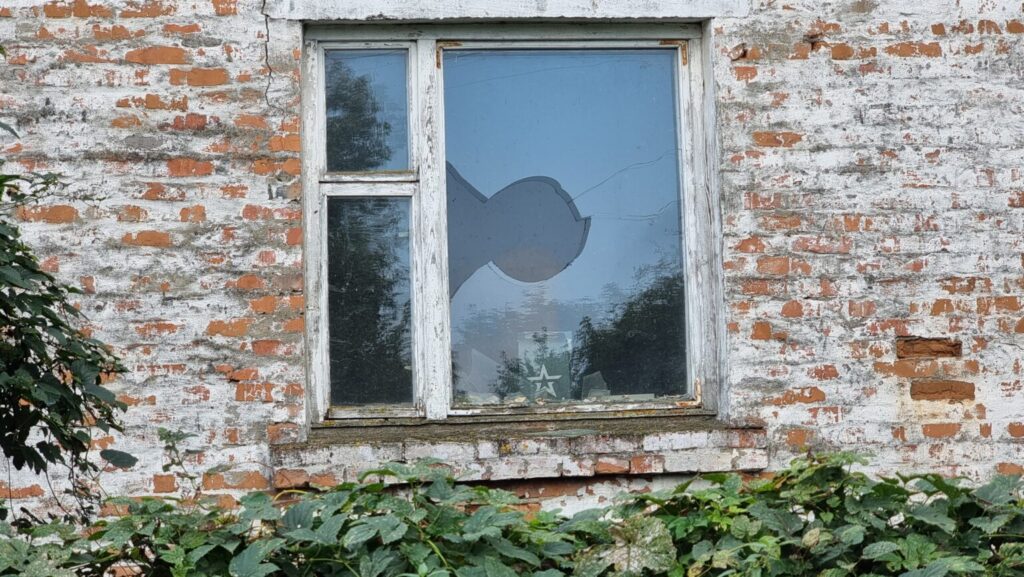
On the way back, we found a Russian dry ration standing on the windowsill of an abandoned house with broken windows.

The material was prepared by Daria Danova and Kristina But as part of the «Truth Through Stories» School.

The project is implemented by the Education Human Rights House (Chernihiv) with the support of the Ministry of Foreign Affairs of the Czech Republic as part of the local transformation project «Ukraine and Ukrainians: Modern Chronicles of the Fighting for Freedom and Democracy».
Frame 295 (3)
Новини

They stole spoons and killed people: a pensioner’s story about russian soldiers in Zolotynka

«We came to liberate you. You will receive a large pension», the occupiers told Mykola when they settled in his country house.

Mykola Luhina lives with his family in Chernihiv, but often visits his cabin in Zolotynka. A small remote village is located approximately 25 kilometers from the regional center. This man keeps an apiary here and grows his own food in a garden.

Before the full-scale invasion, he used to enjoy fishing and collecting mushrooms. He never goes to the forest or to the river anymore because of the signs warning about mining around the village.

«Grads» and tanks were placed near civilians’ houses

On March 3, 2022, columns of the Russian military entered Zolotynka. Some went to the nearby village of Yagidne, while others stayed here. Heavy weapons were placed right in locals yards, thus making civilians a human shield.

«They visited many yards, mine included. I ran out and shouted: where are you going? There was a pile of firewood in the yard at that time. And the soldier immediately headed to the barn», the man recalls.

Later, six Russians came to the pensioner. They searched all the rooms, the attic, the basement and demanded to heat water for their dinner.

«I told them I don’t have gas. Actually I had a bit, but it was running low. Then one of them took a machine gun and started shooting around the room. Bullets went through a bucket, nightstands, a pan, cans of flour. His commander was very angry when he found out about that. He told me to give him a mop and a rag to let him clean», says the pensioner.

They decided to stay at his house. Soldiers felt very confident using local’s belongings and let him stay at the house. So the owner had a chance to see and hear what they were doing.

Under the same roof with the enemy

Almost all the inhabitants of the village had to deal with the unwanted guests. First, Russians of Slavic appearance, and then Buryats and Tuvans. Slavs lived at Mykola’s.

«I have only one room that can be heated, but during that period, while the military was there, not a single door was closed. They were always in bulletproof vests. They couldn’t walk through the door properly. Ukrainian artillery was stationed not so far away, so when they heard «boom», they immediately ran to the cellar.»

Sometimes they even took potatoes from the cellar and also tried to steal spoons from the kitchen. The man laughs while recalling this incident. He says he persuaded them to return the cutlery, telling tales about Koncha-Zaspa and the golden toilets waiting for the Russians near Kyiv.

The pensioner lived with soldiers who did not drink alcohol at all. It was worse in other houses. People were even taken to the toilet at gunpoint. When Russians were drunk, they arranged shootings.

Two locals of Zolotynka were taken somewhere by force. Later, people found out that they were kept in a basement in Yagidne and then killed.

Between these terrible memories, the pensioner also recalls conversations with Russians. He asked why they came and what they wanted here. In response, he heard about liberation and high pensions.

«I told him, look, my grandchildren used to visit me, they were playing and I was happy. And you came and ruined me. It’s not liberation when you destroy everything.»

A few days later, the military left Mykola’s house and drove away from the village. The newcomers were no longer settled, even when a new column arrived in Zolotynka. Then, due to the lack of electricity, the man lived in obscurity for about a month.

«BM-21 Grads» and «BM-27 Uragan» were located not far from his house. He says that sometimes he and his neighbors were sitting in their homes as if in a movie theater: they watched heavy equipment fire shells at Chernihiv, then Kolychivka, and later they fired at Ivanivka.

«Come out, aimer!»

«That day, when it was already dusk, I saw an armored personnel carrier driving and they stopped near me. Viktor Ivanovich was being transported on it. When will he come back, «Not soon» – they said. He never returned. He was also taken to Yagidne. I was told that he was in the basement until he heard the shout: «Aimer, come out.» When our people entered the village, they found him and three others buried,» the pensioner recalls with sadness in his eyes.

Mykola Luhina’s story was recorded in Zolotynka, a year and a half after its de-occupation. The man continues to take care of his farm here. Other locals had returned back home. The village lives almost the same as before the occupation. The only reminders of this hell are mined fields, a burnt-down car, and locals whose stories will not be forgotten.

The material was prepared by Tetiana Pyhurska and Kateryna Trofymenko as part of the «Truth Through Stories» School.

The project is implemented by the Human Rights Education House in Chernihiv with the support of the Ministry of Foreign Affairs of the Czech Republic as part of the local transformation project «Ukraine and Ukrainians: Modern Chronicles of the Fighting for Freedom and Democracy».