12Чер2026
Розуміємо права людини Мережа домів прав людини

контакти

Провулок Луговий, 1 Г,
с. Количівка,
Чернігівський район,

Чернігівська область,
Україна 
15563

+38 0462 930-907
+38 0949 881-907

Frame 319 (1)
Новини

Навчити людей не вмирати. Aша Карсакова

Кожен та кожна з нас має знайти своє місце у цій війні. Спосіб, у який зможе принести найбільше користі. Aша знайшла своє покликання — “навчати людей не вмирати”.

Aша Карсакова вже два роки викладає тактичну медицину для військовослужбовців. Її робота — постійні відрядження в різні регіони України, викладання на полігонах та під обстрілами.
До вторгнення займалась активізмом, проводила чисельні акції на підтримку прав жінок та ЛГБТ+ спільноти, грала у плейбек-театрі і реалізовувалась у найрізноманітніших сферах.

Aша в Playback-театрі

Через перфоманс та театр досліджувала вплив війни на суспільство, в рамках правозахисної діяльності робила форум-виставу про гендерно-зумовлене насильство у Верховній Раді та реалізовувала велику кількість інших проєктів.

Aша має філологічну освіту та педагогічний досвід, тож вирішила, що як викладачка може бути максимально корисною.

 До тактичної медицини її привела особиста втрата — на війні загинув її близький друг. 

“Я важко перенесла цю втрату. І понад усе мені хотілося, щоб ніхто з рідних військовослужбовців ніколи не переживав те, що пережила я”.

Робота на перемогу — складна, виснажлива, часто демотивуюча, травматична, при цьому — найважливіша. 

Aша розповідає про тактичну медицину, складнощі викладання та позитивні зміни у суспільстві, а ще — про навчання, втрати та відновлення.

Тактична медицина по залишковому принципу

За словами Aші, найбільші складнощі в роботі інструкторки з тактичної медицини пов’язані з неправильними уявленнями людей про медицину та її важливість у бойових умовах. Часто потреби в медиках закривають по залишковому принципу, а до підбору персоналу, від роботи якого буде залежати життя, ставляться недбало. Пояснити командуванню, як важливо мати тямущу, навчену та підготовлену людину на посаді медика — не найпростіша задача.

Aша на тренінгу з тактичної медицини

Про те, щоб мобілізуватися самостійно, Aша теж думає. Правда, в сучасній українській армії для цього є ряд перешкод. Система більше підлаштована під чоловіків, їхні потреби та фізіологію, а жінкам часто лишається роль “помічниць” та “підтримки”.

“В мене є подруги, котрі мобілізувалися, бажаючи бути максимально корисними, і вони сильно про це жалкують, тому що їх там саджають на якісь невідповідні їхнім компетенціям і характерам посади. І вони, будучи в лавах Збройних Сил України набагато менш продуктивні, ніж були до цього, коли були волонтерками. Вони йшли воювати і бути корисними, а  їх поставили в такі умови, де вони корисними не можуть бути зовсім”.

Aша Карсакова та “Госпітальєри”

Позитивних змін, щоправда, теж вистачає: за два роки в Україні почав формуватися інститут репутації, а жінки все більше і більше отримують можливості реалізувати себе в армії. 

Ще нещодавно люди одне в одного мало не ножами кидались, а зараз ми все частіше приходимо до продуктивної дискусії”

Інструкторів та інструкторок щодня стає більше, цивільні люди починають краще розуміти важливість домедичної підготовки та проходити курси, а ті, хто навчають людей рятувати себе, починають все частіше і самі звертатися за допомогою. Перш за все — психологічною.

Перша психологічна допомога: як не нашкодити

Aша зізнається: не збожеволіти після початку повномасштабного вторгнення допомогло те, що в цей період вона вже активно працювала з психіатром та психотерапевтом і отримувала підтримку.

Взагалі я — депресивний пиріжечок з дитинства, і в повномасштабку увійшла вже такою, знаєте, психологічно мобілізованою”.

З усім тим, два роки постійного стресу — це занадто велика ноша навіть для добре підготовлених людей.

Якщо чесно, мене тримає думка про те, що шкодити собі — це працювати на ворога”.

Рік тому Aша втратила нареченого на війні. 

Я собі уявляю іноді, що життя — це така тимчасова гра, в яку ми граємо тут, на Землі. А після смерті потрапляємо у справжній світ. І там вже вирішуємо, хочемо ми залишитися і відпочити, чи їхати в нове відрядження. Моя робота — це постійні відрядження, тому я і переклала свій досвід на таку, власне, глобальну міфологію.”


Щоб впоратися з втратою, зверталася до різноманітних програм психологічної реабілітації. Щоправда, не всі з них виявилися вдалими. Багато програм, зазначає Aша, обіцяють відновлення та підтримку, на ділі ж їхнім спеціалістам часто бракує елементарної емпатії.

Уявіть собі: починається знайомство з психологами, і одна зі спеціалісток при повному залі вдів виходить та каже: привіт, я Таня, я психологиня і у мене є чоловік. Ну… вітаємо, що тут ще сказати”.

Ще один проєкт психологічної реабілітації виявився мертвим чатом у Телеграмі, в якому нічого не відбувається — от тільки на восьме березня опублікували привітання “з днем весни, краси і жіночності”.

Перезавантаження

Коли останній “реабілітаційний проєкт” з’їв безліч сил та місяць часу на відновлення, стало ясно, що необхідно шукати інші джерела підтримки. Aша раніше вже брала участь у заходах Освітнього дому прав людини —Чернігів, тому коли побачила запрошення на Програму психосоціальної реабілітації — вирішила залишити заявку. 

“Мені зателефонував Геннадій, сказав, що мене будуть дуже раді бачити. Я подумала: ого, на мене чекають!

Участь в програмі нагадувала дитячий табір — один із тих, в яких Aша колись і сама працювала. 

“Це було і навчання, і відпочинок, і реабілітація. Половину дня ми вчилися, а потім — відпочивали. Це просто казка. І масаж! Це дуже-дуже було корисно.”

Aша уважно спостерігала за методологією викладачів та психологинь, намагаючись придумати, як застосувати набуті знання у її роботі викладачки тактичної медицини. 

“Я звертала увагу на те, що можна імплементувати в моє викладання. От, наприклад, перерви для перезавантаження — це дуже важливо. І цукерочки для того, щоб мозок працював — це теж дуже важливо!”

Але найбільше Aша запам’яталася порада однієї з тренерок.

Якщо відреагувати на ситуацію одразу, вона потім не переросте у скандал, адже скандал — це маленька заноза, яку не витягли вчасно.

Стосується кожного

На питання про те, що кожна цивільна людина має знати про домедичну допомогу, Aша відповідає просто: як мінімум пройти курси з зупинки кровотечі та серцево-легеневої реанімації. І завжди мати при собі засоби зупинки масивної кровотечі. Турнікет або бинт не займають багато місця навіть у найменшій сумці.

Aша та тренувальний манекен для відпрацювання навичок надання медичної допомоги

Та головне пам’ятати: аптечка — це не артефакт, що рятує сам по собі. Ми всі маємо здобувати та постійно покращувати свої навички надання допомоги.

Щоби навчитися не вмирати. 

Програма реабілітації функціонує за підтримки ZMINA. Центр прав людини, Human Rights House Foundation, Libereco – Partnership for Human Rights та проєкту ESU.

Проект ESU / Програма «Стійкість» реалізується Фондом домів прав людини у консорціумі громадських організацій на чолі з ERIM International, у партнерстві з Фонд Східна Європа, Human Rights House Tbilisi, Беларускі дом правоў чалавека імя Барыса Звозскава та Black Sea Trust for Regional Cooperation за фінансової підтримки European Union in Ukraine.

ПАКУЛЬ
ДокументуванняНовини

Occupation of the Pakul village

Robbing the local population, plundering the school, detention and torture. The commander sentenced. Briefly on how the Pakul village  residents survived 10 days of Russian occupation.

Who occupied Pakul?

Pakul is an ancient picturesque village in Chernihiv region, located only 10 km away from the Belarus border. Russian troops managed to occupy it nearly a month after the start of the full-scale invasion. The occupation lasted 10 days.

Armen Abgharian (in the middle). Photo: Chernihiv Time (Chas Chernihivskyi).

On the morning of March 21, 2022, servicepeople of the Russian 7th Composite Rifle Company (74th Separate Motorized Brigade) occupied Pakul. The unit was commanded by Armen Abgharyan, a war criminal . The permanent location of the unit is a town of Yurga, Kemerovo region. It was from there that they came to “liberate”, rob and torture the Ukrainian civilian population. Local residents say that the Russian “SOBR” (special rapid response unit) and other Russian Federation military formations were also stationed in the village.

They robbed and looked for “sauna with girls”

Several checkpoints were immediately set up in the village. Russian soldiers of Asian appearance, probably Tuvans or Buryats, were detailed to the checkpoint in the village center. They asked local residents where to find a “sauna with girls”. This terrified the residents of the Pakul as these soldiers posed a potential threat to the women and girls who remained in the occupation. Fortunately, no cases of rape were recorded.

The Russian soldiers were quartered in empty civilian houses, as well as in the premises of the school, forestry and fire department. After they had left the village, it was found that tools  from the school garage were missing. Cooking utensils and all food supplies  from the dining room were missing as well. New mats were taken from the school gym. Farm equipment, cars and trucks, livestock, poultry, food, household items and even underwear were stolen from local residents.

School premises in the village of Pakul. Photo: Education Human Rights House  — Chernihiv.

Inspections and torture

The Pakul residents were searched, every house was checked, phones and documents were inspected at roadblocks. On March 24, 2022, a local resident, Oleg Parasiuk, was detained when going through the checkpoint (he went to feed the dogs). First, russian soldiers interrogated him, then they took him to their headquarters located within the forestry facilities. Oleg was kept in the basement together with another man – Serhii Yakovenko from the village of Vediltsi.

Both prisoners were required to provide information about the Armed Forces of Ukraine. The men were beaten, but they did not tell anything. The next day, Armen Abgharyan, the unit commander,  went down to the basement. He unbuckled his holster, took out a pistol and shot twice at Oleg Parasyuk and three times at Serhii Yakovenko… Oleg Parasyuk’s arm and leg were wounded. Serhii Yakovenko received a shoulder, cheek, upper and lower lip  injuries, and lost five teeth. The men survived and were able to escape, as the basement door had been left unlocked.

In addition, it is known about at least three more people detained in the premises of the forestry.

Basement in the premises of the forestry in the village of Pakul. Photo: Educational House of Human Rights — Chernihiv.

On March 31, 2022, local residents saw a military convoy moving towards Chernihiv. Russian troops were leaving the village, leaving chaos and explosive ordnance behind them…

Journalists managed to identify Abgharian, so law enforcement agencies initiated criminal proceedings. It is known that Russian military personnel from this motorized brigade have been participating in the war against Ukraine since 2014. On September 14, 2023, the court in Chernihiv handed down a sentence and found a Russian serviceperson, Armen Abgharian, the commander of the 74th separate motorized brigade, guilty of ill-treatment of civilian population as well as of giving orders to violate the laws and customs of war. Abgharian was sentenced to 12 years in prison in absentia.


This publication is made possible by the generous support of the American people through the United States Agency for International Development (USAID) in the framework of the Human Rights in Action Program implemented by Ukrainian Helsinki Human Rights Union.

Opinions, conclusions and recommendations presented in this publication do not necessarily reflect the views of USAID, the United States Government. The contents are the responsibility of the authors.

USAID is the world’s premier international development agency and a catalytic actor driving development results. USAID’s work demonstrates American generosity, and promotes a path to recipient self-reliance and resilience, and advances U.S. national security and economic prosperity. USAID has partnered with Ukraine since 1992, providing more than $9 billion in assistance. USAID’s current strategic priorities include strengthening democracy and good governance, promoting economic development and energy security, improving health care systems, and mitigating the effects of the conflict in the east. For additional information about USAID in Ukraine, please call USAID’s Development Outreach and Communications Office at: +38 (044) 521-5753. You may also visit our website: http://www.usaid.gov/ukraine or our Facebook page at https://www.facebook.com/USAIDUkraine.

All images in this material were created using artificial intelligence and are purely illustrative.

Frame 585
Новини

The path of a Zaporizhzhia activist: from volunteering to documenting war crimes

Dmytro’s story is about how everyone can find their place in the fight against the enemy by actively participating in volunteering and civic activities. Ukraine is experiencing the conditions of full-scale war very painfully. Everyone tries to contribute to the fight and victory. Some take up arms and go to the front lines. Some help as volunteers in the rear. But there is another very important area of work – documenting the war crimes committed by Russian occupiers.

The hero of our story today is Dmytro Vakhnenko. His path of volunteering and civic activism cannot be called typical.

Before the full-scale invasion, he was educating people on financial literacy. He enjoyed this field, life was going on as usual, but everything changed dramatically on February 24, 2022.

The First Months

Almost immediately after the start of the Russian military invasion, Dmytro realized that people and the country needed help – he couldn’t stand aside, so he joined as a volunteer to one of the volunteer headquarters in Zaporizhzhia, where he was involved in unloading humanitarian aid and assisting at the warehouse.

Later, Dmytro became the head of the HR department of the organization “Community of Volunteers United by Idea” – he was responsible for coordinating a team of 50-70 people, searching for volunteers, and engaging them in assistance.

“Previously, I worked for a large enterprise in Zaporizhzhia, more precisely, even at a factory, as a leading specialist in the department of analytics and development of the target production model, and it was there that I developed managerial skills, I coordinated the work of departments, so it wasn’t a big problem for me.”

However, even with this experience, the work was very intense at that time because it was necessary to react promptly to changing needs in the conditions of war, – claims Dmytro.

Evidence for future tribunals and volunteering

In October 2022, when Zaporizhzhia was heavily shelled by the occupiers, Dmytro made the decision to temporarily relocate to another city.

“I left the volunteer headquarters around the time I left Zaporizhzhia. After my return, it was no longer operating in the same format as before. So, I began to look for where else I could be useful.”

Despite this, Dmytro understood that he wanted to continue making his contribution to the fight against the enemy in any case – he continued to engage in volunteering. Later, he had the opportunity to join the documentation of war crimes committed by Russians in the public organization “Association of Relatives of Kremlin Political Prisoners” – he took advantage of it.

Currently, his work involves documenting facts of Russian occupiers’ crimes against civilians – killings, torture, and kidnappings.

“The most important thing we do is document the facts of war crimes. If we don’t do this, in the future, we won’t be able to prove that the crimes actually occurred. This is the evidential base for Ukraine, for national and international courts, including the Office of the Prosecutor of the International Criminal Court.”

Interviewing a shelling witness

Also significant here is the informational aspect because the world needs to know the truth about what the Russians are doing in Ukraine, Dmytro claims.

His work consists of two main directions: searching for information in open sources and interviewing witnesses and victims of war crimes.

Dmytro and his organization pass the collected facts and testimonies to analysts, law enforcement, and judicial authorities. Thus, an important evidential base is created for future tribunals against Russian war criminals.

Dmytro admits that he never thought he would be involved in civil or volunteer activities, but now he actively participates in various initiatives.

“For example, together with the community of civil organizations and local volunteers of Zaporizhzhia, we achieved that thanks to public hearings from the city budget, 100 million UAH were allocated to the Armed Forces of Ukraine.”

In addition to this, in 2023, Dmytro donated blood five times, participated in animal volunteering actions, and eco-activism – for his active position, he received thanks for volunteering from the Zaporizhzhia Regional State Administration.

Maintaining Emotional Balance

Working on documenting the horrors of war cannot but affect a person’s psychological state, says the documentarian.

Nevertheless, Dmytro believes that personally, this activity had an even more positive impact on him. After all, he got the opportunity to prevent impunity, convey the truth about the war, and also learn a lot about methods of collecting and analyzing information.

“I also continue to engage in volunteer and civic activities, so I constantly have to be resourceful – for this, of course, I try to take care of my condition so that in the future I can bring even more benefit.”

To maintain emotional balance, Dmytro advises finding time for relaxation and self-improvement, participating in trainings and events that help with recovery.

“In October, for example, I took part in an urgent support program and a 7-day psychosocial rehabilitation program from the Educational Human Rights House in Chernihiv – it helped me restore my emotional state to continue working in the future.”

Although Dmytro knew about the Human Rights House before, the program itself was told to him by the head of the organization he currently works for.

The overall atmosphere during the program played a big role: the program was closer to nature – there the pace of life, according to Dmytro, feels more peaceful, which helps to recover.

Dmytro also remembers the variety of new people from different regions of Ukraine, other participants in the support program. They were all part of an active civil society, so the rehabilitation program for Dmytro also became a place where he could find new connections and exchange experiences.

Dmytro in the Educational Human Rights House in Chernihiv together with other participants of the Psychosocial Rehabilitation Program under the ESU project (village Kolichivka)

But the most valuable thing for him was still the sessions with psychologists in individual and group formats.

“I liked the fact that psychologists devoted quite a lot of time to us – we had various psychological practices, I probably can’t name them all now.”

“The program was aimed at deeper understanding of one’s emotional state, restoring inner resources, and hearing oneself – all this together works very effectively.”

Place in the Struggle Dmytro Vakhnenko’s story inspires and makes one think – each of us has our own role and place in resisting the Kremlin’s expansionist policy. He showed an example that it is possible to combine different types of activities – from documenting war crimes to local volunteering.

It is important not to stop, to seek opportunities to contribute to victory, and not to be afraid to take on new directions of work, says Dmytro.

Only through consolidated efforts can we withstand.


The Protection Program operates with the support of the International Renaissance Foundation, Human Rights House Foundation, and the ESU project.

The ESU Project / Resilience Program is implemented by the Human Rights House Foundation in a consortium of civil society organizations led by ERIM, in partnership with the Eastern Europe Foundation, the Human Rights House in Tbilisi, the Belarusian Human Rights House named after Boris Zvozskov, and the Black Sea Regional Cooperation Fund with financial support from the European Union.

Окупація села Левковичі (1)
ДокументуванняНовини

The Killed Civilians and the Open-Air Crematorium: How a Village in Chernihiv Region Survived Occupation

Atrocities of Russian troops during the occupation of a village in Chernihiv region: torture and execution of civilians, burning bodies in plain sight, and shelling civilian homes.

The spring of 2022 marked the beginning of tragedy for one village in the Chernihiv region. On that fateful morning, locals were startled by the frantic screams of a mother, echoing for kilometers. Gathering at the village’s central cross, they found the snow-covered bodies of four of their fellow villagers lying in a row. In a state of shock and deep sorrow, relatives used carts and sleds to transport the deceased, burying them in their own yards until better times…

This is the story of crimes committed by Russian soldiers in one of the villages in Chernihiv region. It is told from the testimonies of eyewitnesses, documented by representatives of the Human Rights House – Chernihiv.

Names of the deceased and their relatives have been changed.

Torture and execution of four civilian men

On February 24, 2022, villagers learned of the war’s onset from televisions and calls from loved ones. Later, they heard explosions outside the village. On February 27, Russian military vehicles rumbled through the village streets. The following day, Russian soldiers brutally killed four local men, marking the beginning of the village’s occupation, which lasted a month.

On the eve of March 1, 2022, at least four families stayed awake all night, their men not returning home. Until 7-8 in the morning, each family held onto hope, thinking they might have been delayed due to the occupation, spending the night with friends.

This hope dissipated for Petro first. Early in the morning, he went to search for his son Roman. He walked about a hundred meters from his home to the village’s central cross and saw the bodies of four men. Petro’s heart raced with dread; inside, everything churned with anticipation of impending tragedy. With great difficulty, he approached closer: among the dead was his 33-year-old son.

The tragedy reached Roman’s mother next. The woman collapsed near the cross, wiping the snow from her son’s face and screaming, “My son!!! For what???”. People heard this wild, inconsolable cry of a mother who lost her child from a kilometer away.

Katerina learned of her husband’s death, 34-year-old Stepan, next. Following her, Paulina was wounded by the news of her husband’s murder, 46-year-old Maxim. Julia came to collect her father’s body, 51-year-old Victor, with sleds, the last to know. She lived farthest from the center.

People transported the bodies of the slain to their homes and, as best they could, prepared them for burial. Thus, on the first day of spring, Stepan found his resting place in the garden, where he had planned to plow with his brand-new tractor that year. Maxim was buried beneath the window of the house he loved so much. And Roman – in the orchard, where as a child he loved to taste apples and cherries. Only Julia managed to bury her father in the cemetery: she lacked the strength to bring him home herself, but acquaintances helped her bury him in the cemetery.

Russian soldiers tortured all four unarmed villagers. Their bodies bore gunshot wounds to the genitals and legs, massive bruises, gun and stab wounds.

Murder of civilians and deaths due to lack of medication

On March 11th, the village came under shelling. Homes, streets, and most importantly, people, were affected.

“Uncle Vitya, save dad! Grandma is already dead,”

– with these words, a terrified girl ran to her neighbor.

That day, her grandmother Olena and grandfather Mykita from her father’s side were killed in the shelling. The husband had just come to bring things when a shell hit. Mykita died on the spot. Olena groaned for half an hour: her leg was torn off, so she slowly bled out and died. To alleviate her suffering in any way, the rural paramedic injected painkillers when she could reach the scene.

The son of the landlady, Mykola, also suffered a severe leg injury. But the man survived. He was taken to a neighbor who once served in the navy and knew the basics of first aid. He advised Mykola’s wife to pack the wound to stop the bleeding.

And you know, she packed that wound. Her father was just killed, her mother-in-law died… But she gathered herself and managed to organize conditions for her husband to survive. Luckily, the paramedic had antibiotics. She injected them into the wounded man, so his condition stabilized. After the village was liberated, he was treated in Ukraine and abroad,” says a neighbor of the family who witnessed the events.

However, six villagers did not survive the occupation: they died due to a lack of specific medications and proper medical care. Among the deceased was the father of the tortured Stepan – Mykhailo. These people were also buried in their own yards.

“Open-air crematorium”

The battles for Chernihiv region lasted from February 24th to March 31st. The enemy repeatedly tried to take Chernihiv and was met with resistance. In many occupied villages, people provided coordinates of enemy equipment and locations of Russian troops. Based on this information, the Ukrainian Armed Forces struck. Consequently, the enemy suffered considerable losses.

Many villagers testify that Russian soldiers burned the bodies of their own soldiers. This happened on the territory of a destroyed grain storage.

According to locals, Russian soldiers transported the bodies with ambulances. Then they unloaded them near the demolished grain storage, poured something over them, and set them on fire. They finished off the wounded: villagers heard shots from the side of the storage.

The flames were violet-blue in color. The stench surrounded the area, making it difficult to breathe. This lasted for two days. During this nearly continuous burning, the concrete slabs on the grain storage resembled torn paper.

“In the first two days, the doors of the body trucks were still closed. Later, I saw hands hanging from the sides… The bodies at the farm burned for two days. From the window, I could see two soldiers taking the body, swinging it, and throwing it into the fire. The third one poured something from a bucket, and it burned. Breathing at that time was difficult, there was black smoke,” said a local resident.

Two years have passed. People are returning to normal life. The destroyed farm has been restored and is operating again. At the cross in the center of the village, the Ukrainian flag flies proudly, and a memorial plaque with the names of the slain villagers stands firmly. It serves as a reminder of the war crimes committed by Russian occupiers here…


The material was prepared by Natalia Naidiuk.

This publication is made possible by the generous support of the American people through the United States Agency for International Development (USAID) in the framework of the Human Rights in Action Program implemented by Ukrainian Helsinki Human Rights Union.

Opinions, conclusions and recommendations presented in this publication do not necessarily reflect the views of USAID, the United States Government. The contents are the responsibility of the authors.

USAID is the world’s premier international development agency and a catalytic actor driving development results. USAID’s work demonstrates American generosity, and promotes a path to recipient self-reliance and resilience, and advances U.S. national security and economic prosperity. USAID has partnered with Ukraine since 1992, providing more than $9 billion in assistance. USAID’s current strategic priorities include strengthening democracy and good governance, promoting economic development and energy security, improving health care systems, and mitigating the effects of the conflict in the east. For additional information about USAID in Ukraine, please call USAID’s Development Outreach and Communications Office at: +38 (044) 521-5753. You may also visit our website: http://www.usaid.gov/ukraine or our Facebook page at https://www.facebook.com/USAIDUkraine.

All images in this material were created using artificial intelligence and are purely illustrative.


Frame 278 (3)
Новини

“Як можна нічого не робити, коли в країні війна?”

Ганна Бут — вчителька та волонтерка з Мелітополя, лауреатка відзнаки “Національна легенда України”, заслужена працівниця освіти. Розповідає про протести, окупацію, відновлення та півтисячі її “бійців-зайців” 

Ганна Бут займається волонтерством з 2015 року. Підтримувала мелітопольські дитячі будинки, організовувала заходи для дітей, позбавлених батьківського піклування. Ганна виховувалась у сиротинці, тож як ніхто знає, наскільки діти там чекають на спілкування, тепло та турботу. 

Тоді ж, у 2015, Ганна разом з колегами заснувала у своєму навчальному закладі волонтерський рух “Свічадо” для допомоги армії. Збирала допомогу для військових і паралельно з цим виховувала майбутніх героїв на уроках громадянської освіти. 

Ганна Бут (у блакитній сукні) з колегами-вчителями

Понад 500 її колишніх учнів наразі воюють

Зізнається: колись вона і сама пішла у військкомат, і, якби не здоров’я, певно, зараз вже неодмінно була б у лавах ЗСУ. 

Сьогодні Ганна з дочкою знаходиться у місті Дубно Рівненської області і ні на хвилину не перестає жити волонтерськими турботами. Весь її вільний час проходить у плетінні сіток, збиранні посилок, відправці допомоги і пошуках нових способів залучити людей до волонтерської праці.

Жити в такому режимі постійно — невимовно важко, але ще важче — відчувати, що робиш недостатньо. 

Ганна з дочкою змогли вирватись з окупованого Мелітополя, перебратися у безпечне місто Дубно, і — майже одразу відновити там волонтерську діяльність.  Але дорога в безпеку виявилась довгою, важкою і травматичною — фізично та морально.

                                                                                                                                70 днів в окупації

Ганна зізнається: до останнього не вірила у можливість повномасштабного вторгнення.
Моя дочка Крістіна готувалась до війни, збирала тривожний рюкзачок, а я спочатку тільки сміялась з цього”
Коли ж це сталося, вони одразу почали ходити на щоденні протестні акції разом з тисячами інших мелітопольців. 

Ганна з донькою Крістіною на протесті

За день проходили стільки кварталів, що стерли пару взуття”

Активні протести тривали до 18 березня, а потім аж до початку травня протестувальники збиралися на міжконфесійну молитву на головній площі міста. Паралельно з цим долучалися до акції “Жовта стрічка”. Ганна згадує: спочатку використала всі стрічки, що мала вдома, потім — все, що взагалі можна було застосувати до справи: нитки, тканину,  навіть жовту парасольку. 

“Ми робили все, щоб показати ворогу, що йому тут не раді”

Разом з дочкою Ганна розвішувала стрічки всюди, де нема людей — на стовпах та деревах. А іноді вдавалась і до більш ризикованих методів.

Я придумала, як вішати стрічки в магазинах. Ставала спиною, наприклад, до холодильника, ніби щось роздивляюсь, і в’язала стрічку до ручки. Потім відходила, дивилась на неї і раділа”.
Перебувати в окупованому місті ставало дедалі небезпечніше. Скоро почалися дзвінки з невідомих номерів серед ночі. Голос в слухавці погрожував і називав її “бандерівською потворою”. Згодом невідомі стали телефонувати та дихати в слухавку. Стало зрозуміло, що настав час за будь-яку ціну покинути місто.
Останньою краплею став день, коли на центральній площі міста спустили прапор України — найбільший прапор у Запорізькій області.

“У мене ніби вибили землю з-під ніг, я довго не могла прийти до тями. Ми з дочкою по черзі плакали: спочатку я плачу і вона мене втішає, а потім навпаки.”

Виїхати з окупованого міста було важко. З собою — тільки домашні тварини та трохи речей, а на шляху — 26 блокпостів.

“Дочка сказала мені мовчати, тож я рахувала блокпости. Один під мостом, ще один десь в кущах…”

Окупанти на блокпостах всі, як один, були брудні та голодні — відібрали у когось з автобуса хліб та воду. Чоловіків роздягали та перевіряли на наявність патріотичних татуювань. Дорога була важкою та виснажливою.

Коли ми доїхали до Запоріжжя, то вклонялись там кожному українському прапору.

Я дивилась на мирне місто і від шоку не могла розмовляти, здається, кілька днів. Тут люди ходять по вулицях, співають, танцюють, а в цей же час в Мелітополі голодують. Як ми не з’їхали там з глузду? Мені здається, тільки тому, що розуміли: якщо ми зляжемо, то нікому не зможемо допомогти. У мене стільки хлопчиків-бійців потребують допомоги, я їх називаю — “мої зайці”. Хлопці мені розповідають про те, як воюють, як автомати в руках у них червоні, бо стільки ворогів лізе, що вони не встигають охолонути. Ну скажіть мені, як я можу не займатися тим, чим займаюся?”

Після Запоріжжя Ганна з дочкою рушили в Дубно, де і залишаються зараз. 


“Головна мотивація — повернутись додому”

В Дубно у Ганни вистачає роботи. Весь час, вільний від проведення онлайн-уроків, Ганна присвячує волонтерству. 

“Простіше було б сказати, чим я не займаюся. Наразі плетемо маскувальні сітки. Запити ніколи не зменшуються, навпаки — їх стає все більше і більше. Мені тільки вартує сказати, що вже майже кінець… Буквально позавчора прийшли два величезних запити. Допомагаємо всім, хто звертається, не тільки своїм учням або випускникам”. 

Ганна розповідає, як постійно працює над тим, аби залучити до волонтерської роботи якомога більше місцевих. Як особисто приходить до підприємців та просить у них долучитися до зборів. 

“Перед дзвінком підприємцю я завжди молюся. Дуже хвилююсь, що відмовить. Але інші люди ще менше долучаються до зборів, у всіх є свій клопіт, у кожного тут по кілька людей з сім’ї на війні”

Завдяки її ініціативі до плетіння сіток долучаються вчителі та учні з місцевих навчальних закладів, ліцеїв та училищ. Нещодавно Ганна звернулась до директора Дубенського замку (замок князів Острозьких — Любомирських, фортеця в місті Дубно Рівненської області) — і тепер в її команді дві музейні працівниці. 
Найстаршій волонтерці — 67 років. Любов Костюк плете іграшки, які Ганна надсилає у Фінляндію, де їх продають на благодійних ярмарках. Іншій волонтерці, теж з Мелітополя, Ганна надсилає на продаж розмальовані гільзи.

“Всі мелітопольці, які втекли, волонтерять, це не секрет. Наша основна мотивація — бажання повернутися додому. Якщо я не встану сьогодні з ліжка, я ні на сантиметр не наближуся до Мелітополя.”


Ганна з дочкою та тваринами евакуюється з Мелітополя


Ганна зізнається: спогади з окупації їй майже вдалося залишити позаду. Тільки іноді, після особливо важкого дня, буває тяжко.

Дуже важко стає, коли Крістінки вдома нема, закінчились всі активності, лишаєшся сама вдома і вимикаєш світло… Дуже хочеться відчути запах рідного дому.”

Найважче — лишатися наодинці зі своїм горем. На щастя, у Ганни була можливість звернутися по допомогу.

“Іноді треба поставити крапку і дати собі відпочити”

Ганна розповідає:

У мене був важкий травматичний випадок під час волонтерської роботи, після якого я отримала мікроінсульт в правій частині головного мозку. Було темно в очах, я не могла підвестися. Це така травма, знаєте, психосоматична. Пов’язана з неприйняттям нечесності та неправди. Я зрозуміла, що дуже багато віддаю свого життя волонтерській роботі”.

Тоді Ганна вирішила податись на Програму психосоціальної реабілітації від Освітнього дому прав людини в Чернігові. Там волонтерка, за її словами, вперше за 52 роки відчула стільки поваги для себе. Змогла привести свої почуття до ладу. Досі використовує вправи з самодопомоги, яким навчила її тренерка Надія Локоть.

Волонтерам, які відчувають, що вигоріли, Ганна радить обов’язково звертатися по допомогу, адже самостійно не впоратись. Багато організацій надають психологічну допомогу, і можливість відчути теплоту та повагу до себе — неоціненна. 

Якщо відчуваєш, що здоров’я підводить — одразу став крапку та відпочивай, звертайтесь до лікарів.

“Волонтерам найбільше потрібна підтримка людей, які готові щось змінювати в країні. І сміливість стукати у двері, просити про підтримку своїх зборів, бо люди видихаються. Хто кому хто — ми відповімо після війни. А зараз понад все важливо підтримувати одне одного і дбати про себе”. 


Програма реабілітації функціонує за підтримки ZMINA. Центр прав людини, Human Rights House Foundation, Libereco – Partnership for Human Rights та проєкту ESU.

Проект ESU / Програма «Стійкість» реалізується Фондом домів прав людини у консорціумі громадських організацій на чолі з ERIM International, у партнерстві з Фонд Східна Європа, Human Rights House Tbilisi, Беларускі дом правоў чалавека імя Барыса Звозскава та Black Sea Trust for Regional Cooperation за фінансової підтримки European Union in Ukraine.

Окупація села Левковичі (2)
ДокументуванняНовини

Occupation of Levonky village

Levonky is a small village located in the Chernihiv region, about 25 kilometers from the regional center. About a hundred people live here, and the only one of its kind in Ukraine, the “Regional Center for Social Adaptation,” is located here. It was created mainly for people without a permanent place of residence.

On March 30, 2022, two columns of Russian military vehicles entered the village. On the way, they shot the transformer, immediately cutting off the electricity. After arriving in the village, Russian soldiers selected six local men for work and forced them to saw fallen trees that blocked the bridge over the river. They began conducting searches, trying to find Ukrainian soldiers and those who blocked their path.

“Pray, because your life is over…”

The men sawed the trees and returned. About 20 minutes later, Russian soldiers came back to the houses and took them, leading them to the territory of the Center for Social Adaptation. They took phones from everyone and interrogated them.

The soldiers took the men to the courtyard, made them kneel down, and tied their hands with ropes. They fired shots in different directions, threatening to shoot them. They told one of them, “Pray, because your life is over, we will kill you now, don’t worry—it will be quick.” Then they brought his father and also interrogated and fired shots over his head. Another local resident was beaten, and they threatened to deal with his family.

Later, the Russians took everyone to another room. There was a cage where the men were placed. They had guards and sometimes the commander visited. The men managed to escape only when the Russian military left the village.

Plundering and Destruction

Russian soldiers did not bypass the Center for Social Adaptation and stayed there for a day. They spent the night in a building that the staff used as a warehouse. They stole equipment, mattresses, pillows, dishes, and chairs. They left a mess. Russian soldiers even took things from a second-hand store that were brought here as humanitarian aid. Moreover, they shot two cows from the farm, which were taken care of by the center’s wards.

They looted the houses of local residents, taking whatever they liked. In one cellar, they threw a grenade. Moreover, in the village, Russian soldiers were often seen in a state of drunkenness.


The inscription left by Russian soldiers in the village club: “Forgive us, we came for the Bandera supporters. And there are looters among everyone :)”. Photo provided by witnesses.

Tank with an Explosive Before leaving the village, the wards of the Center were locked in a separate room. Witnesses said that meanwhile, Russian soldiers looted, poured fuel into one of the tanks, set it on fire, and closed the hatch. It burned for about an hour, and then exploded with such force that the tank’s caterpillar flew over the roof, it was found about 150 meters from the explosion site. Another piece of iron buried in the ground damaged the main water pipeline. The utility building collapsed nearby. The tank wheel pierced the trunk of a century-old tree, which fell. Nearby houses were damaged, the ceiling collapsed at the Center for Social Adaptation, windows were smashed, and so on. People managed to get out and put out the fire.

Volunteering

Since the beginning of the full-scale invasion, the wards and employees of the Chernihiv Regional Center for Social Adaptation have been engaged in volunteering. They fed people in Chernihiv who were in bomb shelters with milk from the Levonka farm and other products. They delivered supplies to the blockaded city 25 kilometers away, even during shelling.

Even in just a few days of occupation, local residents were able to experience firsthand what “Russian world” is and how they could help others.


The preparation of informational materials became possible thanks to the Human Rights in Action Program, implemented by the Ukrainian Helsinki Human Rights Union with the support of #USAID. The views and interpretations presented here do not necessarily reflect the views of the US government, USAID, or #UHHRU. The authors and UHHRU are solely responsible for the content of the publication.

Окупація села Левковичі (1)
ДокументуванняНовини

Occupation of the village of Levkovichi

On February 28, 2022, the first column of Russian troops passed through the village of Levkovychi in Chernihiv region, starting an occupation that lasted just over a month. During this period, the Russians brutally killed local residents, detained and tortured them. People also died from shelling and lack of medicine. Houses in the village were damaged and looted.

On January 5, our documentarians visited Levkovychi and recorded evidence of war crimes committed in February-March 2022.

Russian soldiers shot dead four men: Oleksandr Orishko, Oleksandr Derkach, Yaroslav Varava, and Serhiy Nemchenko. Local residents heard gunfire, and later their fellow villagers found them dead. The bodies had numerous gunshot and stab wounds, as well as signs of beating. The men were tortured by Russian soldiers and then killed. The bodies of the deceased were found in the center of the village, right next to the cross. It is known that the men were preparing Molotov cocktails to stop columns of Russian troops, but they had no weapons. Their lives were cut short on the first day of the occupation.

The man who walked from Slavutych to Levkovychi was detained and taken prisoner. The Russians decided to make him a “messenger.” To make him agree, they tortured him, cutting crosses with a knife where tattoos were on his arms and legs. To prevent him from escaping, they went to his parents’ house and took his father hostage. The man was sent to Slavutych to deliver a letter to local authorities. What was written there is unknown, as there was no opportunity to see.

Witnesses who agreed to be interviewed spoke of looting by Russian soldiers. They looted uninhabited houses, and where people lived, they entered and took food, cars, livestock, and even underwear. Shops and the village council were also looted. Local farmers also suffered from abuses by Russian soldiers. Agricultural machinery on a farm in the village was destroyed and shot at. Russian army soldiers used fuel stocks prepared by the farmer for sowing and destroyed grain stocks.

Знищене зерносховище у селі Левковичі

There are many damaged houses in the village, with about 150 of them having damage. They suffered not only from shelling but also from Russian soldiers placing vehicles near houses and firing at Chernihiv. Two people died from shelling. These are Sotnyk Vitaliy and Tovkun Nina. Nina’s son, Oleg Tovkun, was injured and is still undergoing rehabilitation abroad.

The residents of Levkovychi lived in constant fear during the occupation. Civilians were threatened with death, for example, for violating the order not to look towards Russian soldiers or for refusing to accept food under the guise of humanitarian aid. They were forbidden to walk around the village or talk to each other. Living conditions in the occupation were also complicated by the lack of electricity, gas, communication, and especially medicine. In these conditions, six elderly people died in the village.

This continued until April 3, 2022, the day Levkovychi was liberated.


The preparation of this informational material was made possible thanks to the Human Rights in Action Program, implemented by the Ukrainian Helsinki Human Rights Union with the support of #USAID. The views and interpretations presented here do not necessarily reflect the views of the US Government, USAID, or #UHHRU. The authors and Educational Human Rights House – Chernihiv are solely responsible for the content of the publication.


Окупація села Левковичі
ДокументуванняНовини

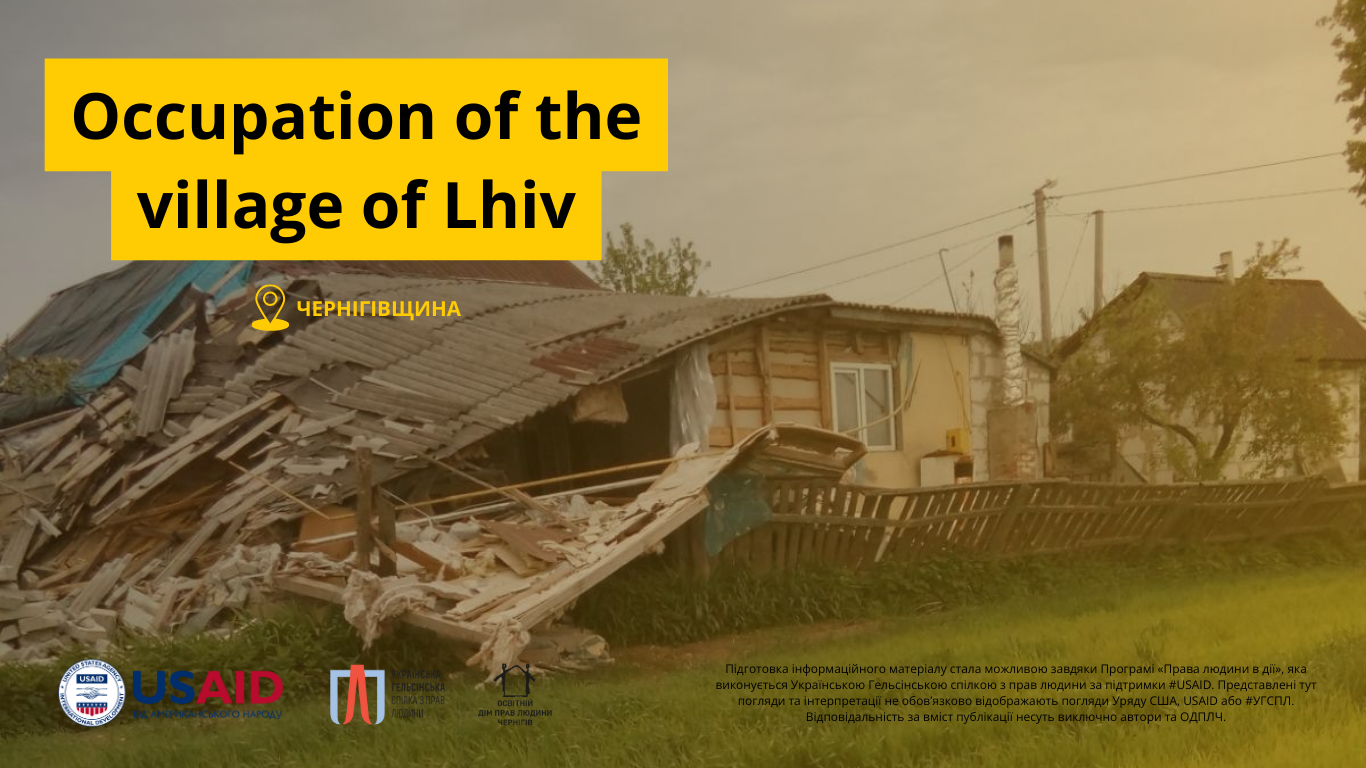
Occupation of the village of Lhiv

The village of Lhiv is located in the Chernihiv region, approximately 50 km from the border with Belarus. In February-March 2022, the settlement was partially occupied. Russian troops entered Ukrainian territory from Belarus. According to local residents, about a thousand soldiers arrived in the village. They placed equipment under buildings and shelled Chernihiv. Trenches were dug throughout the village.

They immediately looted the local store and settled near the forest, in the quarry. Russian military personnel lived in civilian houses, and there were cases where homeowners, even with children, were expelled.

Local residents were detained and constantly checked. Russian soldiers did not allow men to leave the yard, only women and children. They were told that if they saw someone outside twice, they would be shot. They could stop, kneel down, interrogate, or search.

One of the local residents served in the Ukrainian Armed Forces. He was demobilized half a year before the full-scale invasion but had never fought in the East. They took him out onto the street in the middle of the night, beat him, abused him, and tried to extract information. The Russians left him tied up on the street, where he spent four days. He spent the first night even without outerwear. But later, they released him.

The entire family suffered from the rampage of Russian military personnel. Later, journalists managed to identify the commander, Ruslan Kuliyev from Magnitogorsk, who committed war crimes. Also, his subordinate Andriy Chudin, who beat the man. On November 2, the Novozavodsk district court of Chernihiv sentenced these two Russian servicemen in absentia, accused of abusing residents of the occupied village.

They fired at civilian cars. A couple from Kuvychi was driving from Kuvychi to Chernihiv in a car with white flags. The man needed hemodialysis, so the family tried to reach the hospital. Russian troops shelled their car with the BM-27 Uragan MLRS. As a result of the shelling, the car caught fire, the man died, and the woman was injured. Russian soldiers put her in an armored personnel carrier and took her to the village of Luhiv, which was already under their occupation at that time. A local veterinarian and hairdresser removed the bullet, performed bandages, and saved the wounded woman.

During the occupation, there was no electricity, gas, or water in the village. Locals cooked food in ovens, cauldrons, or on the street. There was no communication either. Houses and cars in the village were destroyed and burned.

Before leaving, Russian troops robbed houses and took everything they found valuable, even domestic animals or poultry. In the morning of April 1, 2022, they left the village.


The preparation of this informational material was made possible by the Human Rights in Action Program, implemented by the Ukrainian Helsinki Human Rights Union with the support of #USAID. The views and interpretations presented here do not necessarily reflect the views of the US Government, USAID, or #UHHRU. The authors and UHHRU are solely responsible for the content of the publication.

Frame 308
ДокументуванняНовини

Voices from liberated Kherson region: civilian captives, torture chambers in schools and Russian marauders

On March 31, 2022, 42-year-old accountant Tetiana Veresyuk from Lyubymivka School, along with her nephew, fell into captivity. After a 9-hour interrogation, they were released with the expectation that they would be shot at the first checkpoint…

This is the story of a 7-month occupation of the village of Lyubymivka. It’s about how Russian military forces raided, looted people, turned schools into torture chambers, and warehouses for looted goods and ammunition. And despite the ordeal, Ukrainian teachers continue to educate children not only from areas under control but also from the occupied territories of Kherson region.

The text is based on documented testimonies from Lyubymivka school employees – accountant Tetiana Veresyuk and director Aliona Gergel for the project of the Civil Society “Educational Human Rights House – Chernihiv”. With the financial support of the Czech organization People in Need, within the SOS Ukraine initiative.

“February 24 came as a shock to us. But it was the same shock as in 2014”

The village of Lyubymivka is located in the Beryslav district of Kherson region. Only 25 km away from the front line across the Dnipro River (as of January 2024). When Russian troops arrived here in March 2022, they thought it was a city because of how well-maintained and modern it was.

“Of course, February 24 was a shock to us. But it was the same shock as in 2014, when Donetsk and Luhansk were ‘burning.’ We understood: something terrible was happening. But we fully realized and felt it after March 10, when the occupiers entered our village,” begins Tetiana Veresyuk, the accountant of the local school.

Before the war, 167 children from surrounding villages attended Lyubymivka’s comprehensive school. They traveled to school by the school bus.

On the morning of February 24, the school’s director, Aliona Gergel, called an acquaintance who was a policeman to understand how serious the military situation was in the region. Upon hearing that it was very serious, they decided to switch to online learning.

“Only technical staff and teachers came to school. We prepared shelters so that people from the village could hide there from shelling. We have a large basement that runs under the entire building. We stocked up on water, arranged beds for the children. Later, more than a hundred villagers of all ages took shelter here,” says the school principal, who lives in the neighboring village of Trudoliubivka.

The day of the occupation for Lyubymivka started the same as before. But everything changed after 3 p.m., when Russian military vehicles passed through the edge of the village…

“Occupiers shelled the village and blamed it on the Ukrainian Armed Forces”

On March 10, Russian tanks, APCs, and other equipment stayed overnight behind the village. The next morning, the occupiers shelled Lyubymivka for the first time. Then they entered the village and told the locals that it was done by the Ukrainian Armed Forces.

“Later, we saw how the Russians repeatedly drove out of the village, deployed tanks, mortars, and fired at Lyubymivka. And then they blamed our people for these shelling incidents. There are many witnesses to this,” says Tetiana Veresyuk.

From March 11 to March 14, villagers were forbidden from leaving their yards. Most likely, during those days, the main enemy forces and equipment arrived in Lyubymivka. Then, for three days, people were given a ‘green corridor.’ They were only allowed to go towards the occupied coastal villages, Kherson, and Crimea. Those who dared to go to the free Novovorontsovka were threatened with being shot in the back. Then, out of 1,500 people in the village, only 375 remained. Among those who left was Tetiana Veresyuk. With her family, they settled in Mykhailivka, which was under ‘quiet’ occupation, 37 km away from the woman’s home.

In Lyubymivka, the occupiers initially settled in farm buildings: workshops, pigsties, and machinery sheds. At first, they only looted the destroyed houses left by the owners. And later, says Tetiana, they came up with a new tactic: to shoot at wealthy estates, thus forcing people to request evacuation. After the departure of the owners, these houses were also looted.

“During the 7 months of occupation, there were 4–5 rotations of Russians in the village. It looked like raids by robbers. After the third wave, there were no valuable items left in the village. Once, people heard one occupant complaining to another: he promised his wife to bring a freezer, but there was no such thing in the village anymore. He was very upset about it,” recalls Tetiana.

Due to shelling in Lyubymivka, 10 people of different ages died. Eight of them were buried in their own yards because the occupiers only allowed two hours for this. According to Tetiana, there was no transportation for the people anymore. Therefore, there was not enough time to transport and bury the deceased.

“In captivity, we were constantly interrogated about how we prepared for the war”

Russian soldiers took civilians, both men and women, from Lyubymivka and surrounding villages as prisoners. Some were held captive for months, others for just a few hours. But the most brutal were the Russian National Guard troops.

“Many so-called DPR members were stationed at checkpoints and in villages. Some of them warned us: the Russian National Guard would raid, hide women, girls, and young men… I know of six people from Lyubymivka who were taken captive. In our school, the captives were usually held for up to two days, then released or transported to the school in the village of Bilyaivka. There was a real torture chamber,” shares Tetiana Veresyuk.

From March 31, 2022, the occupiers were supposed to close off Lyubymivka for entry and exit. To get their belongings, Tetiana and her husband’s nephew went home. And on their way to Mykhailivka, at the Osokorivsky checkpoint, Russian soldiers took them captive. It happened around 11 o’clock.

They took away people’s documents, phones, blindfolded them, put them in an APC, and drove them somewhere. Since Tetiana knew the local roads, she guessed it was the Khreshchenivska school. People were kept there until 8 p.m.

“In captivity, we were constantly interrogated about how we prepared for the war. The commander of several of our villages, ‘Vostok’, was particularly meticulous. He called himself either Serhiy Volodymyrovych or Volodymyr Serhiyovych. He was from Donetsk, he knew Ukrainian. He asked about ATO participants, the Armed Forces, families of soldiers who went to war. We said we didn’t know anything because they themselves banned movement around the village… In general, Russian soldiers constantly said terrible things to us. They were awful words, they poured out hatred… But I still don’t understand what it was caused by,” reflects Tetiana.

The woman and her relative were lucky: despite strong psychological pressure, they were not physically tortured. But there were people in the community who suffered torture. Two boys from the neighboring Trudolyubivka were in captivity twice. They didn’t share details with the villagers, just said that ‘it was everything there.’ After the second time, one of the boys committed suicide.

They sent us home with the expectation that we would be shot at the first checkpoint

At 8 p.m. on March 31, Tetiana and her relative were taken somewhere again. After removing the blindfolds, they saw the same Osokorivsky checkpoint, their car. The curfew began, during which movement was prohibited. But the captives were ordered to go home. They were not given back their documents and phones; they could retrieve them only in two days. They weren’t even issued a pass, as was usually done in such situations. They simply wished them, “drive quietly.” But to get to Mykhailivka, Tetiana and her relative had to pass three enemy checkpoints.

“At the first one, near Shevchenkivka, a young soldier was very surprised that we had no passes. And the senior officer nearby said, ‘Don’t you understand why they let them go? They sent them home with the expectation that they would be shot at the first checkpoint because they’re traveling during curfew without anything.’ We persuaded those soldiers to let us pass. We also passed the second checkpoint, near the village of Zolota Balka. There we were warned to drive slowly because near Mykhailivka, there is a soldier who ‘loses control,’ he shoots at people,” recalls Tetiana with concern.

And indeed, they were almost killed there. People barely managed to get out of the car just before reaching the checkpoint. The crazed occupant shouted that they were traveling during curfew, that he would kill them. Then the chief of that post saved Tetiana and her relative. After arguing with the crazed comrade, he sat in the car with the people and escorted them to the turn to Mykhailivka…

Recovering from what they experienced, Tetiana Veresyuk did not even stop working during the occupation. She says she searched for the internet: sometimes it caught near the Dnipro, sometimes in the attic, and even in straw bales. She managed her Lyubymivka school, as well as another one in a neighboring village and Mykhailivka because the accountants couldn’t work there. When she moved to Kryvyi Rih, she left only her Lyubymivka school behind,” says the accountant.

From a top-rated school, the occupiers made a headquarters, ammunition depots, and storages for loot.

The Lyubymivka school was built in 1973. According to the rankings, it was the second-best in the district. Thanks to participation in the New Ukrainian School program, in recent years, classrooms have been modernized, equipment has been purchased. In particular, chemistry, mathematics, and biology classrooms were updated. They acquired 5 multimedia boards, laptops, printers, laminators, televisions, a 3-D printer, and set up an inclusive room… The school created a modern space where children felt comfortable learning and spending time.

But at the end of April 2022, comfort came to an end: the occupiers burst into the school. They turned the modern educational institution into a headquarters, ammunition depots, and storages for looted goods, a temporary prison for civilian captives. And they expelled the locals from the basement and hid there themselves. To have quick access to shelter, they tore up the floor on the first floor. A sniper was constantly on duty on the roof, shooting at the legs of those who approached the school.

The school’s windows were barricaded with sandbags filled right in the courtyard. In the principal’s office, they set up a toilet: they tore off the boards and used the hole as an outhouse. The biology classroom was used by the Russian military as a firing range.

The school was shelled three times. Two were in June, hitting the gymnasium and the dining hall. The last hit was on September 23, 2022, causing the most damage.

“Shelling was the agony of the Russians. They often went out of the village and fired at it to discredit the Ukrainian Armed Forces. And these were the last days before liberation… When the teachers managed to enter the school, they were shocked. There were a lot of shell casings lying around, the Russians left banners. Ammo crates were on the first floor, in the workshops. They looted everything: equipment, even took the carpentry machines from the workshop. In place of the TVs, we saw inscriptions: ‘There was a TV here.’ There was a stench everywhere. Only one printer remained from the equipment, but they soiled it too: they left their excrement there…” – says director Aliona Hergel with disgust.

Even children from the occupied territories are studying

After the liberation of Lyubymivka, education resumed remotely. At the beginning of the 2022 academic year, 232 children received education in the institution, with 82 students joining from the occupied territories.

“On the left bank, children are forced to attend Russian schools, but they study additionally with us: they complete tasks and send them in. Sometimes six of them join from one gadget. These gatherings were noticed by Russian special services, so it became more difficult for the children to join. But many of these students are still with us,” says the school’s director.

Currently, people are gradually returning to Lyubymivka and neighboring villages. At the beginning of the 2023 academic year, 185 students attended the school. However, there are still problems with gadgets and stable internet connection.

Physical restoration of the school building is not yet being discussed. According to the director, the community does not have the funds for this. Therefore, both children and staff work remotely.

The collective was further united by the ordeal. Currently, Tetiana and Aliona, along with their families, have returned to their native villages. People live in modular houses, as their homes are destroyed. Over the 7 months of occupation, the occupiers destroyed 80% of the village. But people don’t want to go anywhere because here, in the steppe, is their native land…


Prepared by Nataliia Naidiuk.

Frame 278
Новини

“12 years in human rights activism. Perhaps it’s time to take care of myself too?”

In recent years, so much has happened in Ukraine  that human rights activists seem to have adapted to everything… except the need to take care of themselves. Who will save the superheroes who are used to saving others?

We talk to Irina Vyrtosu. Irina Vyrtosu is a human rights activist, expert in non-discrimination and gender equality, and a journalist. She is a co-founder of the civil organizations “BUTY” and “Fight for Right,” and on behalf of the latter, she collaborates with the International Foundation for Electoral Systems (IFES). Irina is involved in the development of an inclusive civic education course for youth called “Democracy through Actions.” She is also a mother.

  On the left is a photo from the family album, and on the right is a picture of Irina at the “Open the Truth Against Violence” rally in support of the ratification of the Istanbul Convention, November 2021. Photo by Natalia Adamovich.

Irina has been advocating for human rights for 12 years. It all started on February 3, 2012. That was when Irina’s first article was published as part of her collaboration with the “Center for Human Rights Information” (now “ZMINA”), marking the beginning of a decade-long partnership. Subsequently, there were many years of fruitful work and struggle, protests and actions, projects, and dialogues with the authorities. During this time, human rights advocacy in Ukraine underwent a profound transformation — both the challenges and the ways of overcoming them became completely different. The human rights activists themselves also changed, and many of them realized that they need the same care that they are accustomed to giving to others. Irina Virtosu is among them.

What has changed in 12 years?

Irina explains that the country has always had problems, but the mechanisms for addressing them remained limited for a long time. Twelve years ago, the maximum one could expect was the opportunity to go out with a placard in the square and hope it wouldn’t end in a police van.

“We then monitored all cases of torture in police departments, had special instructions on how to act at rallies. We had many conversations with activists from Belarus and Russia—back then, there was still hope that something could be done together.”

Since then, through the efforts of activists and human rights defenders, much has changed. The crucial aspect is that it became not just possible to reach out to officials but also to make changes in collaboration with them, be partners, and propose better solutions.

The Human Rights Academy for journalism teachers, 2021 – from the family album.

The human rights movement itself became more professional—more tools of influence emerged beyond “tents and posters.” It became possible to set our own agenda, emphasize what matters to us, convey it to the authorities, and use tools that were once unthinkable.

“I was very happy for colleagues who organized an international human rights conference right in the Kyiv metro (‘Human Rights in Dark Times’ 09.12.22). At that time, Kyiv was under shelling, and it was very dangerous to hold events. My colleagues, in collaboration with the Ombudsman’s Office, organized a conference where they talked about human rights violations during the war, addressed issues in Crimea, discussed human rights protection—all on a partnership level. Ten years ago, this was unimaginable.”

Moreover, numerous civil organizations have emerged that disagree with the old approaches to government interaction. They seek new formats, engage social media, and begin to activate those who are accustomed to working by old rules.

“When you’ve been hitting a wall for 12 years, at some point, you start to notice changes: here was a solid wall covered in grass and mold, and now it’s transparent with the prospect of government accountability to the public.”

How not to burn out?

It’s crucial to separate your activities—be it human rights advocacy, volunteering, or any other—and your personal life. However, saying it is easier than implementing it. Irina recalls how, at the beginning of her career, inspired by numerous opportunities for learning and professional self-realization, she immersed herself entirely in her work, facing burnout as a result.

“There were times when I would come back from one trip and immediately prepare for another, and when I couldn’t find time to do laundry, I would just buy new clothes.”

Then came the birth of her child and maternity leave, bringing with it a real fear of falling out of the work scene and losing connections. However, she had to reduce her work pace to be with her daughter, and balancing both was extremely challenging—until the child started attending kindergarten.

And then came new challenges: working in quarantine conditions, transitioning to a new online work format, and later…

“Then, after a serious illness, my mother passed away. Eventually, by the end of 2021, I realized that my resources were not at zero, but at minus 100.”

Challenges were compounded by COVID, the need to adapt to new work formats. When it finally became clear that there were no more strength reserves, Irina decided to write a resignation letter and take a year off to reflect on everything that had happened and how to move forward. At that moment, a full-scale invasion occurred.

In the first few days, Irina was forced to take her child by the hand and cross the border. They lived there for 8 months.

During the day, she lived in Denmark, learning the language, and at night, she worked for Ukraine. Irina was involved in several projects, researching the evacuation of people with disabilities. There was no talk of vacation at all—there was neither time nor energy. Last year, they returned to Ukraine, and challenges were compounded by the fear for their lives.

“Then I realized that I couldn’t come up with or solve anything. The body says, ‘Come on, you need to rest.’ And there is no perfect time for rest. If you need to sleep, you need to sleep now, not in three years.”

The strength to do something ran out, the meaning faded, and the resources—emotional and financial—were exhausted. In this challenging time, family, friends, and colleagues became her support.

One of Irina’s colleagues advised her to turn to the Human Rights Education House and join the psychosocial rehabilitation program.

“He said, ‘Ira, they are really waiting for you there. You are their client.'”

When and how to ask for help?

The most challenging part, admits the human rights activist, is acknowledging that you need help, that you need someone to take care of you—especially when you’ve been doing it for others for the past 12 years. It becomes truly difficult to stop and recognize where you are.

“You know when it happens? When everything seems ‘fine.’ I took my daughter to Spain, to the warm sea. I’m from Skadovsk, now my hometown is under occupation, and they took away my sea. And here I am in Spain, my child peacefully sleeps at night, and I feel like screaming. Not because I’m in someone else’s Spain but because I could be at home, by my sea, with my loved ones. You go abroad so that your child has a peaceful time for a week or two, to know less about shelling, sleep in the corridor, explosions nearby.”

Irina with her daughter in Skadovsk. Photo from the family album.

Fatigue accumulates and is felt when the body has rested and has the strength for reflection. Then comes the most challenging part—realizing that it’s normal to need help.

Secondly, it’s understanding what you need and asking for it. Following the advice of her colleague, Irina turned to the Human Rights Education House.

“I felt something very valuable—respect for my dignity at different stages of communication with participants and organizers. They called me, clarified my request, and said: even if you don’t take anything from the program, at least you can finally get some rest.”

Irina recalls how she constantly justified herself: it’s not really that bad for her, maybe someone else needs help more. But the trainers quickly explained to her that she needed help, and asking for it is not shameful at all.

She remembers the atmosphere of safety and trust, acceptance of her as she is—an atmosphere in which it was easy to open up.

“I was remembered as the girl who constantly cried.”

Other participants even thanked her for it—thanks to her example, everyone could release their emotions by the end of the program.

She confesses that she went to the program with minimal expectations—just wanted to rest for at least a week. And the program provided that opportunity—unlike her usual training sessions, where everything is scheduled by the hour. In addition to that, it provided new tools for self-care.

“When trainer Nadiia Lokot taught us to greet our pain, it was initially wild for me. And now I constantly say to myself: oh, hello, tension in the neck, long time no see.”

What’s next?

After completing rehabilitation, it’s time to return home—with new tools and self-knowledge.

“I’ve learned to monitor my state. For example, now I know for sure that I need to sleep well because anxiety increases at night. We were trained to be anxious at night, so I need to sleep when there’s an opportunity.”

Weekends are now reserved for herself and her family. Wrapping up in a blanket, watching movies, drinking tea, and absolutely not working.

“They showed me on this program that it can be like this. That it’s normal. I understood what I’m doing, why I’m in Ukraine, why my daughter is here. It lowered the internal pressure.”

Activists are like superheroes who might not sleep for three days, but the resources of the physical body are limited. Irina felt this herself, and now she shares her experience with colleagues.

“I often work with people slightly younger than me. Their eyes are burning, always full of ideas. And I always ask them these simple basic questions: Have you eaten today? Have you slept? Where will you find the time and energy for this idea? I can share my experience and knowledge, my contacts and resources with them, but that’s not all. I want them not to forget about themselves in this drive.”


The rehabilitation program operates with the support of ZMINA. Human Rights Center, Human Rights House Foundation, Libereco – Partnership for Human Rights, and the ESU project.
The ESU Project/Resilience Program is implemented by the Human Rights House Foundation in a consortium of civil organizations led by ERIM International, in partnership with the Eastern Europe Foundation, Human Rights House Tbilisi, Belarusian Human Rights House named after Barys Zvozskau, and Black Sea Trust for Regional Cooperation with financial support from the European Union in Ukraine.