22Лип2026
Розуміємо права людини Мережа домів прав людини

контакти

Провулок Луговий, 1 Г,
с. Количівка,
Чернігівський район,

Чернігівська область,
Україна 
15563

+38 0462 930-907
+38 0949 881-907

Позначка: russian occupation

ПАКУЛЬ
ДокументуванняНовини

Occupation of the Pakul village

Robbing the local population, plundering the school, detention and torture. The commander sentenced. Briefly on how the Pakul village  residents survived 10 days of Russian occupation.

Who occupied Pakul?

Pakul is an ancient picturesque village in Chernihiv region, located only 10 km away from the Belarus border. Russian troops managed to occupy it nearly a month after the start of the full-scale invasion. The occupation lasted 10 days.

Armen Abgharian (in the middle). Photo: Chernihiv Time (Chas Chernihivskyi).

On the morning of March 21, 2022, servicepeople of the Russian 7th Composite Rifle Company (74th Separate Motorized Brigade) occupied Pakul. The unit was commanded by Armen Abgharyan, a war criminal . The permanent location of the unit is a town of Yurga, Kemerovo region. It was from there that they came to “liberate”, rob and torture the Ukrainian civilian population. Local residents say that the Russian “SOBR” (special rapid response unit) and other Russian Federation military formations were also stationed in the village.

They robbed and looked for “sauna with girls”

Several checkpoints were immediately set up in the village. Russian soldiers of Asian appearance, probably Tuvans or Buryats, were detailed to the checkpoint in the village center. They asked local residents where to find a “sauna with girls”. This terrified the residents of the Pakul as these soldiers posed a potential threat to the women and girls who remained in the occupation. Fortunately, no cases of rape were recorded.

The Russian soldiers were quartered in empty civilian houses, as well as in the premises of the school, forestry and fire department. After they had left the village, it was found that tools  from the school garage were missing. Cooking utensils and all food supplies  from the dining room were missing as well. New mats were taken from the school gym. Farm equipment, cars and trucks, livestock, poultry, food, household items and even underwear were stolen from local residents.

School premises in the village of Pakul. Photo: Education Human Rights House  — Chernihiv.

Inspections and torture

The Pakul residents were searched, every house was checked, phones and documents were inspected at roadblocks. On March 24, 2022, a local resident, Oleg Parasiuk, was detained when going through the checkpoint (he went to feed the dogs). First, russian soldiers interrogated him, then they took him to their headquarters located within the forestry facilities. Oleg was kept in the basement together with another man – Serhii Yakovenko from the village of Vediltsi.

Both prisoners were required to provide information about the Armed Forces of Ukraine. The men were beaten, but they did not tell anything. The next day, Armen Abgharyan, the unit commander,  went down to the basement. He unbuckled his holster, took out a pistol and shot twice at Oleg Parasyuk and three times at Serhii Yakovenko… Oleg Parasyuk’s arm and leg were wounded. Serhii Yakovenko received a shoulder, cheek, upper and lower lip  injuries, and lost five teeth. The men survived and were able to escape, as the basement door had been left unlocked.

In addition, it is known about at least three more people detained in the premises of the forestry.

Basement in the premises of the forestry in the village of Pakul. Photo: Educational House of Human Rights — Chernihiv.

On March 31, 2022, local residents saw a military convoy moving towards Chernihiv. Russian troops were leaving the village, leaving chaos and explosive ordnance behind them…

Journalists managed to identify Abgharian, so law enforcement agencies initiated criminal proceedings. It is known that Russian military personnel from this motorized brigade have been participating in the war against Ukraine since 2014. On September 14, 2023, the court in Chernihiv handed down a sentence and found a Russian serviceperson, Armen Abgharian, the commander of the 74th separate motorized brigade, guilty of ill-treatment of civilian population as well as of giving orders to violate the laws and customs of war. Abgharian was sentenced to 12 years in prison in absentia.


This publication is made possible by the generous support of the American people through the United States Agency for International Development (USAID) in the framework of the Human Rights in Action Program implemented by Ukrainian Helsinki Human Rights Union.

Opinions, conclusions and recommendations presented in this publication do not necessarily reflect the views of USAID, the United States Government. The contents are the responsibility of the authors.

USAID is the world’s premier international development agency and a catalytic actor driving development results. USAID’s work demonstrates American generosity, and promotes a path to recipient self-reliance and resilience, and advances U.S. national security and economic prosperity. USAID has partnered with Ukraine since 1992, providing more than $9 billion in assistance. USAID’s current strategic priorities include strengthening democracy and good governance, promoting economic development and energy security, improving health care systems, and mitigating the effects of the conflict in the east. For additional information about USAID in Ukraine, please call USAID’s Development Outreach and Communications Office at: +38 (044) 521-5753. You may also visit our website: http://www.usaid.gov/ukraine or our Facebook page at https://www.facebook.com/USAIDUkraine.

All images in this material were created using artificial intelligence and are purely illustrative.

Окупація села Левковичі (1)
ДокументуванняНовини

The Killed Civilians and the Open-Air Crematorium: How a Village in Chernihiv Region Survived Occupation

Atrocities of Russian troops during the occupation of a village in Chernihiv region: torture and execution of civilians, burning bodies in plain sight, and shelling civilian homes.

The spring of 2022 marked the beginning of tragedy for one village in the Chernihiv region. On that fateful morning, locals were startled by the frantic screams of a mother, echoing for kilometers. Gathering at the village’s central cross, they found the snow-covered bodies of four of their fellow villagers lying in a row. In a state of shock and deep sorrow, relatives used carts and sleds to transport the deceased, burying them in their own yards until better times…

This is the story of crimes committed by Russian soldiers in one of the villages in Chernihiv region. It is told from the testimonies of eyewitnesses, documented by representatives of the Human Rights House – Chernihiv.

Names of the deceased and their relatives have been changed.

Torture and execution of four civilian men

On February 24, 2022, villagers learned of the war’s onset from televisions and calls from loved ones. Later, they heard explosions outside the village. On February 27, Russian military vehicles rumbled through the village streets. The following day, Russian soldiers brutally killed four local men, marking the beginning of the village’s occupation, which lasted a month.

On the eve of March 1, 2022, at least four families stayed awake all night, their men not returning home. Until 7-8 in the morning, each family held onto hope, thinking they might have been delayed due to the occupation, spending the night with friends.

This hope dissipated for Petro first. Early in the morning, he went to search for his son Roman. He walked about a hundred meters from his home to the village’s central cross and saw the bodies of four men. Petro’s heart raced with dread; inside, everything churned with anticipation of impending tragedy. With great difficulty, he approached closer: among the dead was his 33-year-old son.

The tragedy reached Roman’s mother next. The woman collapsed near the cross, wiping the snow from her son’s face and screaming, “My son!!! For what???”. People heard this wild, inconsolable cry of a mother who lost her child from a kilometer away.

Katerina learned of her husband’s death, 34-year-old Stepan, next. Following her, Paulina was wounded by the news of her husband’s murder, 46-year-old Maxim. Julia came to collect her father’s body, 51-year-old Victor, with sleds, the last to know. She lived farthest from the center.

People transported the bodies of the slain to their homes and, as best they could, prepared them for burial. Thus, on the first day of spring, Stepan found his resting place in the garden, where he had planned to plow with his brand-new tractor that year. Maxim was buried beneath the window of the house he loved so much. And Roman – in the orchard, where as a child he loved to taste apples and cherries. Only Julia managed to bury her father in the cemetery: she lacked the strength to bring him home herself, but acquaintances helped her bury him in the cemetery.

Russian soldiers tortured all four unarmed villagers. Their bodies bore gunshot wounds to the genitals and legs, massive bruises, gun and stab wounds.

Murder of civilians and deaths due to lack of medication

On March 11th, the village came under shelling. Homes, streets, and most importantly, people, were affected.

“Uncle Vitya, save dad! Grandma is already dead,”

– with these words, a terrified girl ran to her neighbor.

That day, her grandmother Olena and grandfather Mykita from her father’s side were killed in the shelling. The husband had just come to bring things when a shell hit. Mykita died on the spot. Olena groaned for half an hour: her leg was torn off, so she slowly bled out and died. To alleviate her suffering in any way, the rural paramedic injected painkillers when she could reach the scene.

The son of the landlady, Mykola, also suffered a severe leg injury. But the man survived. He was taken to a neighbor who once served in the navy and knew the basics of first aid. He advised Mykola’s wife to pack the wound to stop the bleeding.

And you know, she packed that wound. Her father was just killed, her mother-in-law died… But she gathered herself and managed to organize conditions for her husband to survive. Luckily, the paramedic had antibiotics. She injected them into the wounded man, so his condition stabilized. After the village was liberated, he was treated in Ukraine and abroad,” says a neighbor of the family who witnessed the events.

However, six villagers did not survive the occupation: they died due to a lack of specific medications and proper medical care. Among the deceased was the father of the tortured Stepan – Mykhailo. These people were also buried in their own yards.

“Open-air crematorium”

The battles for Chernihiv region lasted from February 24th to March 31st. The enemy repeatedly tried to take Chernihiv and was met with resistance. In many occupied villages, people provided coordinates of enemy equipment and locations of Russian troops. Based on this information, the Ukrainian Armed Forces struck. Consequently, the enemy suffered considerable losses.

Many villagers testify that Russian soldiers burned the bodies of their own soldiers. This happened on the territory of a destroyed grain storage.

According to locals, Russian soldiers transported the bodies with ambulances. Then they unloaded them near the demolished grain storage, poured something over them, and set them on fire. They finished off the wounded: villagers heard shots from the side of the storage.

The flames were violet-blue in color. The stench surrounded the area, making it difficult to breathe. This lasted for two days. During this nearly continuous burning, the concrete slabs on the grain storage resembled torn paper.

“In the first two days, the doors of the body trucks were still closed. Later, I saw hands hanging from the sides… The bodies at the farm burned for two days. From the window, I could see two soldiers taking the body, swinging it, and throwing it into the fire. The third one poured something from a bucket, and it burned. Breathing at that time was difficult, there was black smoke,” said a local resident.

Two years have passed. People are returning to normal life. The destroyed farm has been restored and is operating again. At the cross in the center of the village, the Ukrainian flag flies proudly, and a memorial plaque with the names of the slain villagers stands firmly. It serves as a reminder of the war crimes committed by Russian occupiers here…


The material was prepared by Natalia Naidiuk.

This publication is made possible by the generous support of the American people through the United States Agency for International Development (USAID) in the framework of the Human Rights in Action Program implemented by Ukrainian Helsinki Human Rights Union.

Opinions, conclusions and recommendations presented in this publication do not necessarily reflect the views of USAID, the United States Government. The contents are the responsibility of the authors.

USAID is the world’s premier international development agency and a catalytic actor driving development results. USAID’s work demonstrates American generosity, and promotes a path to recipient self-reliance and resilience, and advances U.S. national security and economic prosperity. USAID has partnered with Ukraine since 1992, providing more than $9 billion in assistance. USAID’s current strategic priorities include strengthening democracy and good governance, promoting economic development and energy security, improving health care systems, and mitigating the effects of the conflict in the east. For additional information about USAID in Ukraine, please call USAID’s Development Outreach and Communications Office at: +38 (044) 521-5753. You may also visit our website: http://www.usaid.gov/ukraine or our Facebook page at https://www.facebook.com/USAIDUkraine.

All images in this material were created using artificial intelligence and are purely illustrative.


Окупація села Левковичі (2)
ДокументуванняНовини

Occupation of Levonky village

Levonky is a small village located in the Chernihiv region, about 25 kilometers from the regional center. About a hundred people live here, and the only one of its kind in Ukraine, the “Regional Center for Social Adaptation,” is located here. It was created mainly for people without a permanent place of residence.

On March 30, 2022, two columns of Russian military vehicles entered the village. On the way, they shot the transformer, immediately cutting off the electricity. After arriving in the village, Russian soldiers selected six local men for work and forced them to saw fallen trees that blocked the bridge over the river. They began conducting searches, trying to find Ukrainian soldiers and those who blocked their path.

“Pray, because your life is over…”

The men sawed the trees and returned. About 20 minutes later, Russian soldiers came back to the houses and took them, leading them to the territory of the Center for Social Adaptation. They took phones from everyone and interrogated them.

The soldiers took the men to the courtyard, made them kneel down, and tied their hands with ropes. They fired shots in different directions, threatening to shoot them. They told one of them, “Pray, because your life is over, we will kill you now, don’t worry—it will be quick.” Then they brought his father and also interrogated and fired shots over his head. Another local resident was beaten, and they threatened to deal with his family.

Later, the Russians took everyone to another room. There was a cage where the men were placed. They had guards and sometimes the commander visited. The men managed to escape only when the Russian military left the village.

Plundering and Destruction

Russian soldiers did not bypass the Center for Social Adaptation and stayed there for a day. They spent the night in a building that the staff used as a warehouse. They stole equipment, mattresses, pillows, dishes, and chairs. They left a mess. Russian soldiers even took things from a second-hand store that were brought here as humanitarian aid. Moreover, they shot two cows from the farm, which were taken care of by the center’s wards.

They looted the houses of local residents, taking whatever they liked. In one cellar, they threw a grenade. Moreover, in the village, Russian soldiers were often seen in a state of drunkenness.


The inscription left by Russian soldiers in the village club: “Forgive us, we came for the Bandera supporters. And there are looters among everyone :)”. Photo provided by witnesses.

Tank with an Explosive Before leaving the village, the wards of the Center were locked in a separate room. Witnesses said that meanwhile, Russian soldiers looted, poured fuel into one of the tanks, set it on fire, and closed the hatch. It burned for about an hour, and then exploded with such force that the tank’s caterpillar flew over the roof, it was found about 150 meters from the explosion site. Another piece of iron buried in the ground damaged the main water pipeline. The utility building collapsed nearby. The tank wheel pierced the trunk of a century-old tree, which fell. Nearby houses were damaged, the ceiling collapsed at the Center for Social Adaptation, windows were smashed, and so on. People managed to get out and put out the fire.

Volunteering

Since the beginning of the full-scale invasion, the wards and employees of the Chernihiv Regional Center for Social Adaptation have been engaged in volunteering. They fed people in Chernihiv who were in bomb shelters with milk from the Levonka farm and other products. They delivered supplies to the blockaded city 25 kilometers away, even during shelling.

Even in just a few days of occupation, local residents were able to experience firsthand what “Russian world” is and how they could help others.


The preparation of informational materials became possible thanks to the Human Rights in Action Program, implemented by the Ukrainian Helsinki Human Rights Union with the support of #USAID. The views and interpretations presented here do not necessarily reflect the views of the US government, USAID, or #UHHRU. The authors and UHHRU are solely responsible for the content of the publication.

Окупація села Левковичі (1)
ДокументуванняНовини

Occupation of the village of Levkovichi

On February 28, 2022, the first column of Russian troops passed through the village of Levkovychi in Chernihiv region, starting an occupation that lasted just over a month. During this period, the Russians brutally killed local residents, detained and tortured them. People also died from shelling and lack of medicine. Houses in the village were damaged and looted.

On January 5, our documentarians visited Levkovychi and recorded evidence of war crimes committed in February-March 2022.

Russian soldiers shot dead four men: Oleksandr Orishko, Oleksandr Derkach, Yaroslav Varava, and Serhiy Nemchenko. Local residents heard gunfire, and later their fellow villagers found them dead. The bodies had numerous gunshot and stab wounds, as well as signs of beating. The men were tortured by Russian soldiers and then killed. The bodies of the deceased were found in the center of the village, right next to the cross. It is known that the men were preparing Molotov cocktails to stop columns of Russian troops, but they had no weapons. Their lives were cut short on the first day of the occupation.

The man who walked from Slavutych to Levkovychi was detained and taken prisoner. The Russians decided to make him a “messenger.” To make him agree, they tortured him, cutting crosses with a knife where tattoos were on his arms and legs. To prevent him from escaping, they went to his parents’ house and took his father hostage. The man was sent to Slavutych to deliver a letter to local authorities. What was written there is unknown, as there was no opportunity to see.

Witnesses who agreed to be interviewed spoke of looting by Russian soldiers. They looted uninhabited houses, and where people lived, they entered and took food, cars, livestock, and even underwear. Shops and the village council were also looted. Local farmers also suffered from abuses by Russian soldiers. Agricultural machinery on a farm in the village was destroyed and shot at. Russian army soldiers used fuel stocks prepared by the farmer for sowing and destroyed grain stocks.

Знищене зерносховище у селі Левковичі

There are many damaged houses in the village, with about 150 of them having damage. They suffered not only from shelling but also from Russian soldiers placing vehicles near houses and firing at Chernihiv. Two people died from shelling. These are Sotnyk Vitaliy and Tovkun Nina. Nina’s son, Oleg Tovkun, was injured and is still undergoing rehabilitation abroad.

The residents of Levkovychi lived in constant fear during the occupation. Civilians were threatened with death, for example, for violating the order not to look towards Russian soldiers or for refusing to accept food under the guise of humanitarian aid. They were forbidden to walk around the village or talk to each other. Living conditions in the occupation were also complicated by the lack of electricity, gas, communication, and especially medicine. In these conditions, six elderly people died in the village.

This continued until April 3, 2022, the day Levkovychi was liberated.


The preparation of this informational material was made possible thanks to the Human Rights in Action Program, implemented by the Ukrainian Helsinki Human Rights Union with the support of #USAID. The views and interpretations presented here do not necessarily reflect the views of the US Government, USAID, or #UHHRU. The authors and Educational Human Rights House – Chernihiv are solely responsible for the content of the publication.


Окупація села Левковичі
ДокументуванняНовини

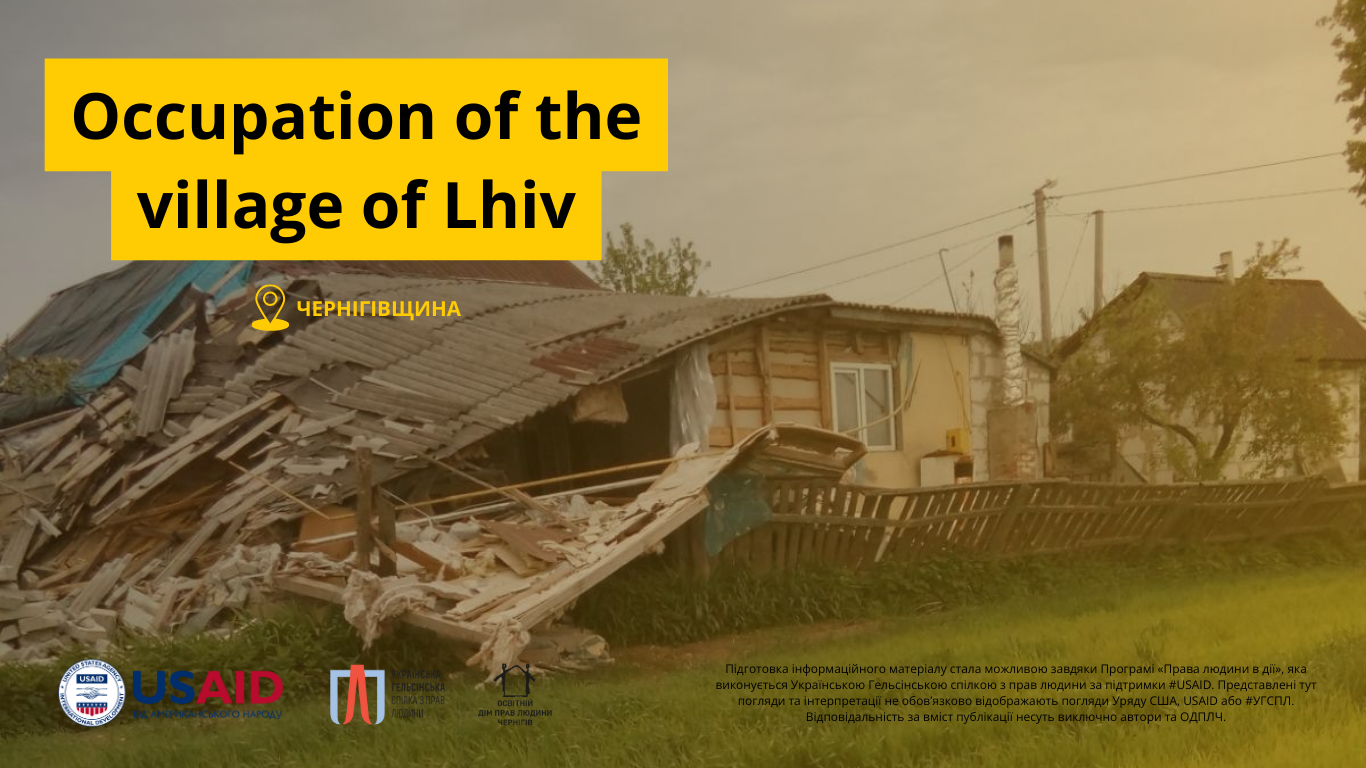
Occupation of the village of Lhiv

The village of Lhiv is located in the Chernihiv region, approximately 50 km from the border with Belarus. In February-March 2022, the settlement was partially occupied. Russian troops entered Ukrainian territory from Belarus. According to local residents, about a thousand soldiers arrived in the village. They placed equipment under buildings and shelled Chernihiv. Trenches were dug throughout the village.

They immediately looted the local store and settled near the forest, in the quarry. Russian military personnel lived in civilian houses, and there were cases where homeowners, even with children, were expelled.

Local residents were detained and constantly checked. Russian soldiers did not allow men to leave the yard, only women and children. They were told that if they saw someone outside twice, they would be shot. They could stop, kneel down, interrogate, or search.

One of the local residents served in the Ukrainian Armed Forces. He was demobilized half a year before the full-scale invasion but had never fought in the East. They took him out onto the street in the middle of the night, beat him, abused him, and tried to extract information. The Russians left him tied up on the street, where he spent four days. He spent the first night even without outerwear. But later, they released him.

The entire family suffered from the rampage of Russian military personnel. Later, journalists managed to identify the commander, Ruslan Kuliyev from Magnitogorsk, who committed war crimes. Also, his subordinate Andriy Chudin, who beat the man. On November 2, the Novozavodsk district court of Chernihiv sentenced these two Russian servicemen in absentia, accused of abusing residents of the occupied village.

They fired at civilian cars. A couple from Kuvychi was driving from Kuvychi to Chernihiv in a car with white flags. The man needed hemodialysis, so the family tried to reach the hospital. Russian troops shelled their car with the BM-27 Uragan MLRS. As a result of the shelling, the car caught fire, the man died, and the woman was injured. Russian soldiers put her in an armored personnel carrier and took her to the village of Luhiv, which was already under their occupation at that time. A local veterinarian and hairdresser removed the bullet, performed bandages, and saved the wounded woman.

During the occupation, there was no electricity, gas, or water in the village. Locals cooked food in ovens, cauldrons, or on the street. There was no communication either. Houses and cars in the village were destroyed and burned.

Before leaving, Russian troops robbed houses and took everything they found valuable, even domestic animals or poultry. In the morning of April 1, 2022, they left the village.


The preparation of this informational material was made possible by the Human Rights in Action Program, implemented by the Ukrainian Helsinki Human Rights Union with the support of #USAID. The views and interpretations presented here do not necessarily reflect the views of the US Government, USAID, or #UHHRU. The authors and UHHRU are solely responsible for the content of the publication.

Frame 327
Новини

Cooperation is power

How a resident of the village Kolychivka in Chernihiv region overcame her own fear and crossed a mined crossroads to help people.

Bright and sunny Lyudmyla Mykolaivna, a resident of the village of Kolychivka in the Chernihiv region, has been a retiree for six years. According to Mrs. Lyudmyla, before February 24, 2022, she was engaged in her home, household, and enjoyed time with her grandchildren. She lived well, content with her life.

“I remember this day. My child made the first call at 6 in the morning and told me terrible news. I was shaken; I didn’t know what to do or where to go… I was alone. After some time, my children came to me.”

Former Activists Never Fade Away

Lyudmyla started going to the stores (at that time, there were still three working), buying whatever she could find. In the first days, the queues were endless, and people were grabbing whatever they could because everyone was in shock. Soon, the stores closed due to a lack of goods.

At the beginning of the invasion, realizing that something needed to be done, Mrs. Lyudmyla began calling the village mayor, asking to organize bread delivery. While the bridge was not yet destroyed, bread was delivered from Chernihiv to the village. Lyudmyla Mykolaivna collected bread for the entire street, carried it, and distributed it to everyone. And when they stopped supplying bread, she partially coordinated when people organized themselves and started baking with what was available.

“Farmer Tkachenko, he brought us milk… we made ends meet as best we could.”

After the occupiers left Ivanivka, life in the village began to recover. Humanitarian aid started arriving in Kolychivka, and Lyudmyla Mykolaivna helped distribute it.

“At first, people couldn’t figure it out… Then we decided to write lists for each street and organized distribution. They began to deliver us bread… We were happy and grateful… For those who lost their home, we searched for housing.”

Crossroads

The memory of the crossroads remains imprinted in Mrs. Lyudmyla’s mind. At first, the explosions could be heard from afar, and then they started getting closer and closer. And at one moment, Kolychivka found itself at the crossroads of shelling.

“It was coming at us from Shestovychi, Ivanivka, Lukashivka, and our side was there too. We didn’t know where and what was flying at first. Then we figured out where ours were. We could be calm; it wasn’t aimed at us.”

In the center of the village, to prevent occupiers from reaching the crossroads, anti-tank mines were placed.

“Everything was laid out here, on both sides of the street. So that when they come, we could stop them…”

On the other side of the village, Mrs. Lyudmyla had grandparents who needed care. The way to them lay through the mined crossroads. For a week, the woman did not visit her relatives, and then she asked a neighbor to guide her through that intersection because she was very afraid. She couldn’t avoid visiting because her relatives were also ill. There were no medicines, no light, and no gas. Every morning, overcoming fear, Mrs. Lyudmyla ran to her relatives before the start of shelling.

Mrs. Lyudmyla did not think that she would have to experience such horror at her age…

But thoughts and concern for others overcame the feeling of fear and fueled the fire of faith in goodness and victory!


The material was prepared by Olena Kozinets and Kateryna Trofymenko as part of the educational course “Truth through Stories.”

The project is implemented by the Educational Human Rights House — Chernihiv with the support of the Ministry of Foreign Affairs of the Czech Republic as part of the local transformation project «Ukraine and Ukrainians: Modern Chronicles of the Fighting for Freedom and Democracy».

Frame 335 (1)
Новини

There is no path dearer than the path home

How Russian occupiers intruded into the lives of the Avramenko family, residents of the village of Pryputni in Chernihiv region

For the inhabitants of the village of Pryputni in Chernihiv region, the full-scale invasion by the Russian Federation became a test of resilience. Pryputni residents had no inkling that on February 25, 2022, a tragic chapter in their village’s history would unfold, marked by loss and an unwavering faith in prompt liberation.

War barged into the lives of Ivan and Maria Avramenko, along with distressing concern—on the very first day, February 24, they had to send their son off to war early in the morning. On the second day, at half-past three in the morning, Russians stormed into the village with gunfire, that’s when dark days of occupation began.

Ivan and Maria didn’t seek refuge elsewhere as their domestic animals needed care. “Grandpa arranged a cellar,” says Maria, “and we spent over a month hiding from shells.”

“Daily several-hour shelling… They stood in the field just 200 meters away,” Ivan points direction with his hand.

Our interlocutor observed helicopters landing on the enemy’s field base, unloading the wounded, and from the window  he saw how peaceful territories were shelled. Every day, the enemy brought in hundreds of deadly weapons and aimed them at people who did not expect this “Russian peace” and were living their quiet lives.

When the Russians first entered Ivan’s yard, he boldly asked them why they had come to his land since no one had invited them. “We came to liberate you,” and the villagers saw the cost of their “liberation” soon. Around each house, there were three or four tanks; when entering homes, they drove out the elderly, women with children onto the streets, and the hosts had nothing left but to move into cellars.

“They ransacked everything in my house,” recalls Ivan. “Even climbed into the attic. They took almost all the goods, even socks. They caught all the chickens, ducks, fried them here, roasted. And so in every house,” laments Ivan.

A little later, our people gave them a worthy rebuff, and it became the first triumphant joy and an unconditional hope that the Armed Forces of Ukraine would definitely liberate Ukrainian villages and cities from the onslaught.

The residents of Pryputni endured about a month and a half of occupation—without warmth, light, and in constant fear for their own and their loved ones’ lives.

“I hid a generator in the cellar,” says Ivan, “so my fellow villagers would secretly come to me and recharge their mobile phones, power banks. I had fuel reserved for trips to the apiary before the war, which is in my forest, so the bees didn’t feel the horrors of occupation,” Ivan jokes and immediately becomes more somber.

Ivan told how his beekeeper friend and his wife went to the funeral on bicycles and found their own death on the way. They were simply shot. Ivan didn’t talk much about himself, but his wife Maria remembered how her husband hid in the forest for a whole day because the occupiers intended to kill him.

Our heroes’ son was fighting for Bahmut while their native village in the north of our country was occupied. He held the eastern positions for 4.5 months. Currently, he is fighting on a different front.

Russian troops left the village on March 30 around half past six in the morning, and our Armed Forces smashed and scattered several hundred units of enemy equipment near Krupichpole.

“You should have seen how they ran like rats from a sinking ship,” our eyewitness enthusiastically recounts. “Scattered in all directions, and our plane chased after them, oh, how it went… It was a pleasure to watch. And when our Ukrainian bird went again, then snow fell and thick fog gathered, which prevented the complete destruction of the enemy on the spot. But a little later, their retribution still caught up with them.

The village is gradually recovering from the consequences of occupation and the atrocities of invaders. People have put their homes in order after fleeing the orcs. However, several dwellings remain completely destroyed, and their owners still live with relatives. But there is hope that people will eventually return to their homes, and the page filled with human sorrow and suffering will close forever, and this story will never repeat itself.

The happiest event during the war for the Avramenko couple was the arrival of their son on short leave. He arrived at his parents’ house with a huge bouquet of flowers. Maria says she has never received such an “infinite” bouquet, and her happiness was the greatest in all the flowers of the world. After all, the son returned, if not for long, from the war.

The embroidered towel made by Maria is an amulet for her son and his comrades. In return, Maria received a gift from the brigade where her son serves: a flag as a symbol of victory and gratitude for the mother of a warrior-defender.


This material was prepared by Lesya Volokh and Nataliya Nesterenko, participants of the educational program “Truth Through Stories,” which is carried out by the Human Rights Education House in Chernihiv with the support of the Ministry of Foreign Affairs of the Czech Republic as part of the local transformation project “Ukraine and Ukrainians: Modern Chronicles of the Struggle for Freedom and Democracy.”

Frame 319
Новини

Russian Occupation: Endurance Test

The Story of Resilience and Unity Among the Residents of Pryputni Village

A typical rural street. Here stands a house, enveloped by trees and viburnum.

Let’s step inside. The courtyard charms the eye with red asters, delicate roses, and dahlias. There is mint, marigolds, and hypericum. Even periwinkle greens up the flower bed. Such a garden could only be maintained by a true hostess. Ludmyla Bunkova, who witnessed the occupation of Pryputni village in Chernihiv region, comes out to greet us.

The morning of February 25, 2022, is forever etched in Ludmyla Ilarionivna’s memory. Since that day, the life of the Bunkov family took a different turn.

“The scariest part was the night when shelling began. You lie down, and shells start flying over the house. They fly so low and loud that you think they will tear the roof off,” recalls Mrs. Ludmyla.

Holding our breath, we listened with interest to this kind woman, who, despite the circumstances, documented events in the occupied village through photos and videos.

“I would hide behind the barn or stand behind the corner of the house, set up the camera, and start filming… My husband argued because he was worried that they might notice,” Ludmyla winks enthusiastically.

A gray cat, regardless of us, carefully climbed onto the bench, then onto the backpack, settled comfortably, and began to doze. The owner smiled, looking at the cat, and continued to tell us how they moved to the cellar during shelling, slept in their clothes, how neighbors began to unite and help each other by sharing grains and bread, and how a neighbor Ivan charged everyone’s gadgets from his generator.

“I will remember this path through the village all my life”

As there was a concentration of Russian equipment in the forest near Ludmyla’s house, the Bunkov family moved to another empty house located in a safer area on the farm.

Ludmyla looked at her house, which she bought shortly before the war. The sun flooded the yard, and the walls of the house suddenly turned bright green in the sunlight. It was here, in this house, that she first met the Russians when she ran home.

“I hastily took things for my grandchildren, because when they were packing, they couldn’t take everything. I’ve heard the door creaked and  then there were cautious steps… I hid. I sat on a stool, and my whole life flashed before my eyes… I sat and thought, ‘Forgive me, God, I am a sinner. I regret not seeing my grandchildren.’ At that time, the sounds of gunfire outside were loud. Someone came into the corridor and asked, ‘Is anyone home?’ I remain silent. And then it dawned on me that I needed to respond. My son is a military man; he warned me that I need to answer. So I shouted, ‘Yes! Yes! Don’t shoot!’ A soldier entered the room and asked, ‘Are you alone?’ I wanted to say something, but I couldn’t squeeze anything out. And he went again: ‘Есть кто дома? А где ваша сємья? А пустиє дома здесь єсть?’ [Is anyone here? Where is your family? Are there any vacant houses here?]”

Mrs. Ludmyla fell silent. It felt like it was hard for her to talk, but she doesn’t show her emotions; she keeps everything to herself. She recalls how, after recovering, she first cried, and when she calmed down, she saw that there were four occupiers: not tall but sturdy, resembling Buryats.

“I answered something to them, but in my head, it was swarming: ‘I need to go… I need to go… My grandchildren are waiting for me in another part of the village…'” I confidently and resolutely went out of the house, explaining on the way to the Russian military that I have no time, that I need to go, that my grandchildren are waiting for me in another part of the village… The occupiers heard me. The machine gunner ordered me to take a piece of white fabric in my hands and not to run but walk slowly along the street. I found a bedsheet, hid two phones under my hands so that the Russians wouldn’t see them (I knew: if they find gadgets, they will take them; if they see photos, then that’s the end for me!), and I went… I walked and told myself, ‘Just don’t run, just don’t run…’ So I walked from one end to the other… Over time, details are forgotten, but I will remember this path through the village all my life,” Ludmyla confesses.

Nowadays, Ludmyla Ilarionivna is striving to regain a sense of normalcy. She speaks with warmth in her voice and a smile about her grandchildren, respectfully recalls her husband who recently passed away. Her grandson Maxim came out of the house, smiled warmly.

It’s time for us to leave… Yet, bidding farewell to this incredible woman, full of strength, endurance, and love, is something we’re reluctant to do…

We’re leaving, accompanied by the slightly bitter-sweet smell of marigolds.

The material was prepared by Iryna Reshetniak and Ihor Protsyk as part of the educational course “Truth Through Stories.”

The project is implemented by the Educational House of Human Rights in Chernihiv with the support of the Ministry of Foreign Affairs of the Czech Republic as part of the local transformation project “Ukraine and Ukrainians: Modern Chronicles of Struggle for Freedom and Democracy.”

Frame 308 (2)
Новини

How the residents of Pryputni survived the Russian occupation

The picturesque village of Pryputni in Chernihiv region is one of many villages that endured Russian occupation. Friendly people live here, still recovering from the temporary occupation.

Residents recount that the Russians did whatever they pleased in the village – rummaging through cellars, catching and slaughtering chickens, forcing homeowners out of their houses, indulging in drinking, and causing havoc. Tanks destroyed houses, a store, fences around the church and school. Much harm was done, but everything can be rebuilt; the lives of seven fellow villagers, however, cannot be recovered—five were shot by Russian forces, and two detonated mines.

For a small village with around three hundred inhabitants, this is a great tragedy, and they can’t stop talking and crying about it.

On February 25, 2022, tanks and heavy equipment of the “Russian world” entered the village.

We meet a local, Hryhoriy Oleksandrovych Oliynyk, born in 1936. He worked as a driver in the local collective farm and later managed a farm. Together with his wife, they raised three daughters and have grandchildren and great-grandchildren.

His wife, Vira Petrovna, passed away in 2003, and he now lives with his daughter Lyudmyla, son-in-law Oleksiy, and grandson Vladyslav in their house. The young man, along with his grandfather, emotionally recounts the atrocities committed by the occupiers in their village.

Killed by Russia

Ten kilometers from Pryputni lies the village of Krupychpole. In mid-March, Yevhen Chemeris and Oleksandr Hryshchenko were traveling there and were shot with a machine gun, burning in their car. This happened in mid-March, according to Hryhoriy Oleksandrovych.

The next story is even more shocking in its cruelty and cynicism. In the neighboring village of Vyshnivka, three kilometers from Priputni, Hryhoriy Prodani’s father died. He and his wife Svitlana were riding on bicycles to the funeral in the morning. Unfortunately, they ran into a column of Russian mercenaries who simply shot the couple. The man died instantly, and the woman died in the hospital. Three children became orphans.

Another emotionally recounted story is about medics Volodymyr and Tetiana Pabat (known as Symoni) who stayed in the occupation with their two children to provide medical assistance. On March 31, 2022, they were returning with their children Hanna and Sasha from the Bezborodkiv hamlet on the edge of the village. Their car hit an anti-tank mine, and the parents died, the children suffered severe injuries yet survived. Now, Hanna is raising her younger brother; he is her entire family.

There are countless tragic stories for the grandfather and grandson. Each story is emotional, and tears cannot be held back.

How Bohdan and his father Mykola stole the “Hurricane”

But there are also stories that truly impress with their bravery. When the occupiers entered the village, as Vladyslav recounts, they looted and robbed the store, so there was no bread to buy for a while. Villagers helped each other survive as best they could. Those with flour baked bread and pancakes and shared them with neighbors. Those who lost their homes were sheltered by fellow villagers. After two weeks, risking their lives, locals started bringing bread from Ichnia. Families with children received a loaf per child, and adults received half a loaf each. That’s how they survived.

Vladyslav’s friend, Bohdan Hryshchenko, together with his father Mykola, residents of Vyshnivka village, stole a “Hurricane” from the occupiers in broad daylight, drove it into the woods, and then handed it over to the Nizhyn Territorial Defense. Ukrainians don’t abandon their own, and they will always come to help, Vlad says.

Epilogue

Life goes on; a cat with kittens joined the family, and they feed them because they are so small and helpless, says Lyudmyla. We wish them health, victory, a peaceful sky, and invite them to Kropyvnytskyi.


The material was prepared by Svitlana Filipova and Oleksander Perevedentsev  as part of the «Truth Through Stories» School.
The project is implemented by the Educational Human Rights House — Chernihiv with the support of the Ministry of Foreign Affairs of the Czech Republic as part of the local transformation project «Ukraine and Ukrainians: Modern Chronicles of the Fighting for Freedom and Democracy».
Frame 238
Новини

Half a jar of flour, a glass of oil, and half a loaf of bread. How the village of Pryputni survived the occupation

The village chief in Chernihiv region tells a story about a month without light, the strength of the community, and what it means to be a hero.

In the morning, it’s warm and calm on the street as my colleagues and I arrive in the village of Pryputni. A man on a bicycle approaches us and introduces himself as Anatoliy Mykolaiovych. Anatoliy is a polite and friendly man who immediately invites us to the village administration. Based on his conversations with local residents, we understand that he is the village chief, well-informed about everything that’s happening. During the occupation, he used to ride his bicycle around the village daily to ensure the well-being of the locals. The village chief explains that we’ve stopped at the same crossroads used by the occupiers as they advanced towards Kyiv, pointing out the affected individuals and buildings. He inquires about everyone’s well-being and what kind of assistance is required.

We introduce ourselves and mention that we are volunteers from Belarus, and we do not support either the occupiers or the dictators. Anatoliy Mykolaiovych agrees to be interviewed.

What were you doing before the full-scale invasion on February 24, 2022?

On February 23, 2022, I was called to the municipal office, where they informed me about what to do in case a war breaks out. We agreed that starting from March 1, I would assume the duties of the village chief.

Could you have left the village?

No, this is the village where I live with my family. I couldn’t leave them or the village.

On February 24, we woke up to the sound of explosions and shelling. The first columns passed through our village. They had good equipment and behaved non-aggressively. They waved to us and allowed us to take pictures and shoot videos. It felt like they were confident that they were welcomed here.

Our village was only used as a transit point for the columns. The occupiers would come to us only when they got lost or needed water. At that time, 350 people lived in the village.

From March 1, the village was cut off from electricity. Local residents rallied together and supported each other as best they could. After a week, their bread ran out, and the local grocery store had only enough supplies for two weeks.

We see how difficult it is for our hero to recall these events, so we pause. During this time, the village chief receives a phone call, and we hear him ask someone what kind of assistance is needed. We understand that he has just helped someone from the villagers.

How did you manage to provide the village with everything it needed?

The village was blocked by the occupiers. They used the paved road, so we had to use dirt and forest paths. These paths went through swamps and were covered in snow. That’s how we made our way to the pontoon bridge. These roads were only suitable for tractors and special vehicles; regular cars couldn’t pass.

A local entrepreneur contacted us through the municipal office. He could deliver 10 bags of flour for two villages, and we divided the seven bags we received among our residents in one-liter jars – 2.5 jars per family. We transported two bags through the forest to a neighboring village, where the residents gave us oil. We distributed half a liter of oil to each family. Unfortunately, it wasn’t enough for everyone. After some time, the same entrepreneur helped us with bread and brought 200 loaves, which amounted to half a loaf per family. The village we were supposed to take the bread from was 12 kilometers away.

How did the villagers behave while the village was under occupation?

There were shelling and bombardments every day. The military noticed that local residents were observing the movement of their equipment, so they started shooting in the air to prevent people from going outside and witnessing what was happening around.

People in the village came together and started helping each other more, putting aside any previous quarrels and disputes. We conducted daily rounds of the village to check on everyone’s well-being. One night, they started shelling a house. They fired armor-piercing and regular bullets. After the attack, we went to check if anyone was hurt, and the homeowner responded. It turned out that the Russian soldiers had been looking for their deserters. Afterward, we relocated the homeowner and her daughter to another house.

How did the occupiers behave?

In the early days, the occupiers shot two of our young men. We found one with a gunshot wound to the head, and the other’s remains consisted of just bones. During the village’s occupation, the occupiers killed seven residents. The last one was killed as we were leaving. We noticed that, after a month, the occupiers became very nervous and started shooting randomly to keep people from going outside. The Ukrainian Armed Forces’ artillery was hitting their positions accurately.

And what about the local residents?

While our village was blocked and there was no way to move between villages, people from neighboring villages gathered to establish logistics. I stayed in the village for a month and couldn’t leave the village because I couldn’t leave the villagers alone, feeling responsible for them. Even when I had to go to the municipal office, I understood that I would be more helpful in the village. My family, my wife, daughter, and son, stayed with me throughout this time.

Unfortunately, we couldn’t defend ourselves, so we did everything we could to help and protect each other and gather information about the enemy’s movements on our land. During this time, we didn’t notice anyone from our village assisting the occupiers or expressing support for the “Russian world.” The church in our village has been Ukrainian for a long time, but there are some parishioners of the Moscow Patriarchate. Even they didn’t show themselves as supporters of the “Russian world.”

So, you are a true hero…

I don’t consider myself a hero—I did everything I could. I organized the construction of roads, personally drove special vehicles to avoid risking people’s lives when the roads were shelled. We succeeded in providing people with essential supplies. We moved the municipal office to a safer location and provided it with electricity when there was no power for a month. My main concern is that people have everything they need, and I’m pleased that people believe in me and offer their support. The villagers collected 100,000 hryvnias for a fence to make our village even more beautiful. We’ve been fortunate with mild winter weather, and it’s been a fruitful year.

We thank Anatoliy Mykolaiovych for the interview, and we continue to talk with him for a long time after the interview ends. The village chief shows us a diary he kept during the occupation, sharing stories about individual villagers and their heroic acts.

But this is a completely different story. Here, every person has their own unique story. Each one did and continues to do everything they can.

And each one is a hero.


Prepared by Alyona Zharkovych and Maksym Dmytrakov within the framework of the “Truth through Stories” School.

Translation from Belorussian: Darya Danova.

This project is implemented by the Human Rights Education House in Chernihiv with the support of the Ministry of Foreign Affairs of the Czech Republic as part of the local transformation project “Ukraine and Ukrainians: Modern Chronicles of Struggle for Freedom and Democracy.”