Новини
How Russian occupiers intruded into the lives of the Avramenko family, residents of the village of Pryputni in Chernihiv region
For the inhabitants of the village of Pryputni in Chernihiv region, the full-scale invasion by the Russian Federation became a test of resilience. Pryputni residents had no inkling that on February 25, 2022, a tragic chapter in their village’s history would unfold, marked by loss and an unwavering faith in prompt liberation.
War barged into the lives of Ivan and Maria Avramenko, along with distressing concern—on the very first day, February 24, they had to send their son off to war early in the morning. On the second day, at half-past three in the morning, Russians stormed into the village with gunfire, that’s when dark days of occupation began.

Ivan and Maria didn’t seek refuge elsewhere as their domestic animals needed care. “Grandpa arranged a cellar,” says Maria, “and we spent over a month hiding from shells.”
“Daily several-hour shelling… They stood in the field just 200 meters away,” Ivan points direction with his hand.
Our interlocutor observed helicopters landing on the enemy’s field base, unloading the wounded, and from the window he saw how peaceful territories were shelled. Every day, the enemy brought in hundreds of deadly weapons and aimed them at people who did not expect this “Russian peace” and were living their quiet lives.
When the Russians first entered Ivan’s yard, he boldly asked them why they had come to his land since no one had invited them. “We came to liberate you,” and the villagers saw the cost of their “liberation” soon. Around each house, there were three or four tanks; when entering homes, they drove out the elderly, women with children onto the streets, and the hosts had nothing left but to move into cellars.
“They ransacked everything in my house,” recalls Ivan. “Even climbed into the attic. They took almost all the goods, even socks. They caught all the chickens, ducks, fried them here, roasted. And so in every house,” laments Ivan.
A little later, our people gave them a worthy rebuff, and it became the first triumphant joy and an unconditional hope that the Armed Forces of Ukraine would definitely liberate Ukrainian villages and cities from the onslaught.
The residents of Pryputni endured about a month and a half of occupation—without warmth, light, and in constant fear for their own and their loved ones’ lives.
“I hid a generator in the cellar,” says Ivan, “so my fellow villagers would secretly come to me and recharge their mobile phones, power banks. I had fuel reserved for trips to the apiary before the war, which is in my forest, so the bees didn’t feel the horrors of occupation,” Ivan jokes and immediately becomes more somber.

Ivan told how his beekeeper friend and his wife went to the funeral on bicycles and found their own death on the way. They were simply shot. Ivan didn’t talk much about himself, but his wife Maria remembered how her husband hid in the forest for a whole day because the occupiers intended to kill him.
Our heroes’ son was fighting for Bahmut while their native village in the north of our country was occupied. He held the eastern positions for 4.5 months. Currently, he is fighting on a different front.
Russian troops left the village on March 30 around half past six in the morning, and our Armed Forces smashed and scattered several hundred units of enemy equipment near Krupichpole.
“You should have seen how they ran like rats from a sinking ship,” our eyewitness enthusiastically recounts. “Scattered in all directions, and our plane chased after them, oh, how it went… It was a pleasure to watch. And when our Ukrainian bird went again, then snow fell and thick fog gathered, which prevented the complete destruction of the enemy on the spot. But a little later, their retribution still caught up with them.
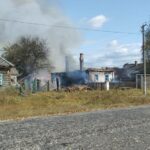
The village is gradually recovering from the consequences of occupation and the atrocities of invaders. People have put their homes in order after fleeing the orcs. However, several dwellings remain completely destroyed, and their owners still live with relatives. But there is hope that people will eventually return to their homes, and the page filled with human sorrow and suffering will close forever, and this story will never repeat itself.
The happiest event during the war for the Avramenko couple was the arrival of their son on short leave. He arrived at his parents’ house with a huge bouquet of flowers. Maria says she has never received such an “infinite” bouquet, and her happiness was the greatest in all the flowers of the world. After all, the son returned, if not for long, from the war.
The embroidered towel made by Maria is an amulet for her son and his comrades. In return, Maria received a gift from the brigade where her son serves: a flag as a symbol of victory and gratitude for the mother of a warrior-defender.
This material was prepared by Lesya Volokh and Nataliya Nesterenko, participants of the educational program “Truth Through Stories,” which is carried out by the Human Rights Education House in Chernihiv with the support of the Ministry of Foreign Affairs of the Czech Republic as part of the local transformation project “Ukraine and Ukrainians: Modern Chronicles of the Struggle for Freedom and Democracy.”