29Сер2026
Розуміємо права людини Мережа домів прав людини

контакти

Провулок Луговий, 1 Г,
с. Количівка,
Чернігівський район,

Чернігівська область,
Україна 
15563

+38 0462 930-907
+38 0949 881-907

Категорія: Документування

Окупація села Левковичі (1)
ДокументуванняНовини

The Killed Civilians and the Open-Air Crematorium: How a Village in Chernihiv Region Survived Occupation

Atrocities of Russian troops during the occupation of a village in Chernihiv region: torture and execution of civilians, burning bodies in plain sight, and shelling civilian homes.

The spring of 2022 marked the beginning of tragedy for one village in the Chernihiv region. On that fateful morning, locals were startled by the frantic screams of a mother, echoing for kilometers. Gathering at the village’s central cross, they found the snow-covered bodies of four of their fellow villagers lying in a row. In a state of shock and deep sorrow, relatives used carts and sleds to transport the deceased, burying them in their own yards until better times…

This is the story of crimes committed by Russian soldiers in one of the villages in Chernihiv region. It is told from the testimonies of eyewitnesses, documented by representatives of the Human Rights House – Chernihiv.

Names of the deceased and their relatives have been changed.

Torture and execution of four civilian men

On February 24, 2022, villagers learned of the war’s onset from televisions and calls from loved ones. Later, they heard explosions outside the village. On February 27, Russian military vehicles rumbled through the village streets. The following day, Russian soldiers brutally killed four local men, marking the beginning of the village’s occupation, which lasted a month.

On the eve of March 1, 2022, at least four families stayed awake all night, their men not returning home. Until 7-8 in the morning, each family held onto hope, thinking they might have been delayed due to the occupation, spending the night with friends.

This hope dissipated for Petro first. Early in the morning, he went to search for his son Roman. He walked about a hundred meters from his home to the village’s central cross and saw the bodies of four men. Petro’s heart raced with dread; inside, everything churned with anticipation of impending tragedy. With great difficulty, he approached closer: among the dead was his 33-year-old son.

The tragedy reached Roman’s mother next. The woman collapsed near the cross, wiping the snow from her son’s face and screaming, “My son!!! For what???”. People heard this wild, inconsolable cry of a mother who lost her child from a kilometer away.

Katerina learned of her husband’s death, 34-year-old Stepan, next. Following her, Paulina was wounded by the news of her husband’s murder, 46-year-old Maxim. Julia came to collect her father’s body, 51-year-old Victor, with sleds, the last to know. She lived farthest from the center.

People transported the bodies of the slain to their homes and, as best they could, prepared them for burial. Thus, on the first day of spring, Stepan found his resting place in the garden, where he had planned to plow with his brand-new tractor that year. Maxim was buried beneath the window of the house he loved so much. And Roman – in the orchard, where as a child he loved to taste apples and cherries. Only Julia managed to bury her father in the cemetery: she lacked the strength to bring him home herself, but acquaintances helped her bury him in the cemetery.

Russian soldiers tortured all four unarmed villagers. Their bodies bore gunshot wounds to the genitals and legs, massive bruises, gun and stab wounds.

Murder of civilians and deaths due to lack of medication

On March 11th, the village came under shelling. Homes, streets, and most importantly, people, were affected.

“Uncle Vitya, save dad! Grandma is already dead,”

– with these words, a terrified girl ran to her neighbor.

That day, her grandmother Olena and grandfather Mykita from her father’s side were killed in the shelling. The husband had just come to bring things when a shell hit. Mykita died on the spot. Olena groaned for half an hour: her leg was torn off, so she slowly bled out and died. To alleviate her suffering in any way, the rural paramedic injected painkillers when she could reach the scene.

The son of the landlady, Mykola, also suffered a severe leg injury. But the man survived. He was taken to a neighbor who once served in the navy and knew the basics of first aid. He advised Mykola’s wife to pack the wound to stop the bleeding.

And you know, she packed that wound. Her father was just killed, her mother-in-law died… But she gathered herself and managed to organize conditions for her husband to survive. Luckily, the paramedic had antibiotics. She injected them into the wounded man, so his condition stabilized. After the village was liberated, he was treated in Ukraine and abroad,” says a neighbor of the family who witnessed the events.

However, six villagers did not survive the occupation: they died due to a lack of specific medications and proper medical care. Among the deceased was the father of the tortured Stepan – Mykhailo. These people were also buried in their own yards.

“Open-air crematorium”

The battles for Chernihiv region lasted from February 24th to March 31st. The enemy repeatedly tried to take Chernihiv and was met with resistance. In many occupied villages, people provided coordinates of enemy equipment and locations of Russian troops. Based on this information, the Ukrainian Armed Forces struck. Consequently, the enemy suffered considerable losses.

Many villagers testify that Russian soldiers burned the bodies of their own soldiers. This happened on the territory of a destroyed grain storage.

According to locals, Russian soldiers transported the bodies with ambulances. Then they unloaded them near the demolished grain storage, poured something over them, and set them on fire. They finished off the wounded: villagers heard shots from the side of the storage.

The flames were violet-blue in color. The stench surrounded the area, making it difficult to breathe. This lasted for two days. During this nearly continuous burning, the concrete slabs on the grain storage resembled torn paper.

“In the first two days, the doors of the body trucks were still closed. Later, I saw hands hanging from the sides… The bodies at the farm burned for two days. From the window, I could see two soldiers taking the body, swinging it, and throwing it into the fire. The third one poured something from a bucket, and it burned. Breathing at that time was difficult, there was black smoke,” said a local resident.

Two years have passed. People are returning to normal life. The destroyed farm has been restored and is operating again. At the cross in the center of the village, the Ukrainian flag flies proudly, and a memorial plaque with the names of the slain villagers stands firmly. It serves as a reminder of the war crimes committed by Russian occupiers here…


The material was prepared by Natalia Naidiuk.

This publication is made possible by the generous support of the American people through the United States Agency for International Development (USAID) in the framework of the Human Rights in Action Program implemented by Ukrainian Helsinki Human Rights Union.

Opinions, conclusions and recommendations presented in this publication do not necessarily reflect the views of USAID, the United States Government. The contents are the responsibility of the authors.

USAID is the world’s premier international development agency and a catalytic actor driving development results. USAID’s work demonstrates American generosity, and promotes a path to recipient self-reliance and resilience, and advances U.S. national security and economic prosperity. USAID has partnered with Ukraine since 1992, providing more than $9 billion in assistance. USAID’s current strategic priorities include strengthening democracy and good governance, promoting economic development and energy security, improving health care systems, and mitigating the effects of the conflict in the east. For additional information about USAID in Ukraine, please call USAID’s Development Outreach and Communications Office at: +38 (044) 521-5753. You may also visit our website: http://www.usaid.gov/ukraine or our Facebook page at https://www.facebook.com/USAIDUkraine.

All images in this material were created using artificial intelligence and are purely illustrative.


Окупація села Левковичі (1)
ДокументуванняНовини

Вбиті цивільні та крематорій просто неба: як село на Чернігівщині пережило окупацію

Звірства російських військ під час окупації одного з сіл на Чернігівщині: катування та розстріли мирних жителів, спалення тіл просто неба та обстріли цивільних будинків.

Весна 2022 року для одного з сіл на Чернігівщині розпочалася з трагедії. Того ранку місцеві здригнулися від несамовитого крику матері, який було чути за кілометр. Згодом люди зійшлися до хреста у центрі села і побачили, як у ряд лежать припорошені снігом тіла чотирьох їхніх односельців. У стані шоку та глибокого горя рідні тачками та санями забирали вбитих, аби поховати їх на власних подвір’ях до кращих часів…

Це історія* про злочини російських військових в одному із сіл Чернігівської області. Вона написана зі свідчень очевидців тих подій, які зафіксували представники Освітнього дому прав людини — Чернігів.

*Імена загиблих та їхніх рідних змінені. 

Катування та розстріл чотирьох цивільних чоловіків

24 лютого 2022 року селяни дізналися про початок війни з телевізорів і дзвінків рідних та близьких. Згодом почули вибухи за селом. 27 лютого сільськими вулицями з гулом пройшла російська техніка. А вже наступного дня російські військові жорстоко убили чотирьох місцевих чоловіків. Так почалася окупація села, яка тривала місяць.

Напередодні 1 березня 2022 року щонайменше чотири родини не зімкнули очей: чоловіки з їхніх родин не повернулися додому. Але до 7-8 ранку кожна з сімей плекала надію: вони просто не встигли дістатися домівок через окупацію і заночували у друзів.

Спочатку ця надія покинула Петра. Рано вранці він відправився шукати сина Романа. Пройшов близько ста метрів від дому до хреста у центрі села і побачив тіла чотирьох чоловіків. Пульс батька зашкалював, від передчуття очевидного лиха всередині все переверталося. Петро насилу підійшов ближче: серед убитих був і його 33-річний син.

Другою про трагедію дізналася мама Романа. Жінка впала біля хреста, обтирала сніг з обличчя сина і кричала: “Синок!!! За що???”. Цей несамовитий, дикий крик матері, яка втратила дитину, люди почули за кілометр від місця трагедії.

Катерина дізналася про смерть свого чоловіка, 34-річного Степана, третьою. Після неї звісткою про вбивство свого чоловіка, 46-річного Максима, поранилася Поліна. Юлія прийшла з санями забирати тіло батька, 51-річного Віктора, останньою. Вона жила найдалі від центру.

Люди відвезли тіла убитих по домівках і, як могли, підготували їх до поховання. Відтак у перший день весни Степан знайшов свій спочинок на городі, який того року збирався орати своїм новеньким трактором. Максим – під вікном будинку, який він так обожнював. А Роман – у саду, де малим любив куштувати яблука та вишні. Тільки Юлії вдалося поховати батька на кладовищі: довезти додому жінці не вистачило сил, а зробити це на цвинтарі допомогли знайомі.

Російські військові знущалися над усіма чотирма беззбройними селянами. На їхніх тілах прострілені геніталії та ноги, величезні синці, вогнепальні та колоті рани.

Убивства цивільних і смерті від нестачі ліків

11 березня село обстріляли. Постраждали будинки, вулиці, а найголовніше – люди.
“Дядя Вітя, рятуйте тата!!! Бабуся вже мертва”, – з такими словами до сусіда прибігла нажахана дівчинка.

Того дня від обстрілів загинули її бабуся Олена по батьковій лінії та дідусь Микита по материній. Чоловік якраз прийшов занести речі, коли прилетів снаряд. Микита загинув на місці. Олена ж ще пів години стогнала: у неї відірвало ногу, відтак вона повільно сходила кров’ю і помирала. Аби хоч якось полегшити її страждання, сільська фельдшерка вколола знеболююче, коли змогла дістатися до місця події.

Син господині Микола теж отримав важке поранення ноги. Але чоловік вижив. Його перенесли до сусіда, який колись служив у морфлоті і знав основи першої домедичної допомоги. Він порадив дружині Миколи тампонувати рану, аби зупинити кровотечу.

“І знаєте, вона тампонувала ту рану. У неї тільки-но вбило батька, загинула свекруха… Але вона зібралася і змогла організувати чоловіку умови так, аби той вижив. На щастя, у фельдшерки були антибіотики. Вона колола їх пораненому, тож його стан стабілізувався. Після звільнення села він лікувався в Україні та за кордоном”, – розповідає сусідка родини, яка була свідком тих подій. 

Але шестеро селян окупацію не пережили: вони померли через нестачу специфічних препаратів та належної медичної допомоги. Серед цих загиблих – батько закатованого Степана – Михайло. Цих людей місцеві так само ховали на власних подвір’ях.

“Крематорій” просто неба

Бої за Чернігівщину тривали з 24 лютого до 31 березня. Ворог неодноразово намагався взяти Чернігів і отримував відсіч. Так само у багатьох окупованих селах люди передавали координати розташування ворожої техніки та місця скупчення російських військових. По них ЗСУ завдавали удари. Відтак ворог зазнав чимало втрат.

Багато селян свідчать про те, що російські військові спалювали трупи своїх солдатів. Це було на території зруйнованого зерносховища.

За словами місцевих, російські військові возили тіла санітарними машинами. Потім вивантажували їх біля розбитого зерносховища, обливали чимось і підпалювали. Поранених вони добивали: селяни чули постріли з боку сховища.

Полум’я було фіолетово-синього кольору. Навкруги стояв сморід, тому дихати було важко. Це тривало два дні. За час такого майже безупинного горіння бетонні перекриття на зерносховищі стали схожі на порваний папір.

“У перші два дні двері труповозки були ще закриті. Пізніше я бачила, як з бортів звисали руки… Трупи на фермі палили дві доби. З вікна мені було видно, що двоє солдатів брали тіло, розгойдували й кидали у багаття. Третій чимось поливав з відра і воно горіло. Дихати в цей час було важко, стояв чорний дим”, – розповіла місцева мешканка.

***

Минуло два роки. Люди повертаються до звичного життя. Відновило роботу й зруйноване фермерське господарство. Біля хреста у центрі села майорить український прапор та намертво стоїть меморіальна дошка з іменами закатованих селян. Як спомин про воєнні злочини, які тут вчинили російські окупанти…


Матеріал підготувала Наталія Найдюк.

Дана публікація стала можливою завдяки щедрій підтримці американського народу, наданій через Агентство США з міжнародного розвитку (USAID) в рамках Програми «Права людини в дії», яка виконується Українською Гельсінською спілкою з прав людини.

Погляди та інтерпретації, представлені у цій публікації, не обов’язково відображають погляди USAID, Уряду США. Відповідальність за вміст публікації несуть виключно автори.

У світі, USAID є однією з провідних установ у сфері розвитку, яка виконує роль каталізатора цих процесів та допомагає досягати позитивних результатів. Діяльність USAID є проявом доброчинності американського народу, а також підтримує просування країн-отримувачів допомоги до самостійності та стійкості та сприяє забезпеченню національної безпеки та економічного добробуту США. Партнерські стосунки з Україною USAID підтримує з 1992 року; за цей час, загальна вартість допомоги, наданої Україні з боку Агентства, склала понад 9 млрд. доларів США. До поточних стратегічних пріоритетів діяльності USAID в Україні належать зміцнення демократії та механізмів досконалого врядування, сприяння економічному розвитку та енергетичній безпеці, вдосконалення систем охорони здоров’я та пом’якшення наслідків конфлікту у східних регіонах. Для того, щоб отримати додаткову інформацію про діяльність USAID, просимо Вас звертатися до Відділу зв’язків з громадськістю Місії USAID в Україні за тел. (+38 044) 521-57-53.

Також пропонуємо завітати на наш вебсайт: http://www.usaid.gov/ukraine, або на сторінку у Фейсбук: https://www.facebook.com/USAIDUkraine.

Усі зображення в цьому матеріалі створені за допомогою штучного інтелекту та мають виключно ілюстративний характер.

Окупація села Левковичі (5)
ДокументуванняНовини

Окупація села Пакуль

Пограбування місцевого населення та школи, затримання й катування людей. Вирок командиру. Коротко про те як жителі села Пакуль пережили 10 днів російської окупації. 

Хто окуповував Пакуль?

Пакуль мальовниче та стародавнє село на Чернігівщині, що розташовується всього за 10 км від кордону з Білоруссю. Російським військам вдалося окупувати його майже через місяць після початку повномасштабного вторгнення. Окупація тривала 10 днів.

Армен Абгарян (посередині). Фото: Час Чернігівський.

Вранці 21 березня 2022 року військовослужбовці 7-ї зведеної стрілецької роти 74-ї ОМСБр рф зайняли Пакуль. Командував підрозділом військовий злочинець Армен Абгарян. Постійне місце дислокації цих військових м. Юрга, Кемеровської області. Саме звідти вони прибули “звільняти”, грабувати та катувати українське цивільне населення. Місцеві мешканці розповідають, що в селі також дислокувався російський “СОБР” (спеціальний загін швидкого реагування) та інші військові формування рф.

Грабували, шукали “баньку и девочек”

В селі відразу поставили декілька блокпостів, один з яких у центрі села. На ньому чергували російські військові азійської зовнішності, ймовірно, тувинці або буряти. Вони запитували в місцевих мешканців де знайти “баньку и девочек”. Це неабияк жахало жителів села Пакуль, адже ці військові несли потенційну загрозу жінкам і дівчатам, що залишилися в окупації. На щастя, випадків зґвалтування не зафіксовано.

Російські військові розселилися в пустих цивільних будинках, на території школи, лісництва та пожежної частини. Після їх виходу із села, виявили, що в шкільному гаражі відсутні інструменти, із їдальні зник посуд для приготування їжі та всі запаси продуктів. Зі спортивної зали забрали нові мати, що призначені для занять спортом дітей. У місцевих жителів викрадали господарський інвентар, легкові та вантажні автомобілі, худобу, птицю, харчі, речі домашнього вжитку та навіть натільну білизну.

Приміщення школи в селі Пакуль. Фото: Освітній дім прав людини — Чернігів.

Перевірки та катування

Пакульців обшукували, перевіряли кожен будинок, влаштовували на блокпостах огляди телефонів та документів. 24 березня 2022 року місцевий мешканець Олег Парасюк намагався перетнути блокпост, їхав годувати собак, але його затримали. Спочатку посадили на стілець і допитували, згодом вивезли на територію лісового господарства, де у російських військових був штаб. Олега тримали у підвалі разом зі ще одним чоловіком Сергієм Яковенком із села Ведильці.

Від обох полонених вимагали передати інформацію про Збройні сили України. Чоловіків били, але вони нічого не розповідали. Наступного дня до підвалу спустився командир підрозділу Армен Абгарян. Розстібнув кобуру, дістав пістолет і двічі вистрілив в Олега Парасюка та тричі в Сергія Яковенка.. Олега Парасюка було поранено в руку та ногу, Сергію Яковенку прострелено щоку, він отримав поранення верхньої та нижньої губи, плеча, втратив п’ять зубів. Чоловіки вижили та змогли втекти, двері підвалу залишилися незамкнуті.

Окрім того, відомо про щонайменше ще трьох людей, яких примусово утримували на території цього лісового господарства.

Підвал на території лісового господарства в селі Пакуль. Фото: Освітній дім прав людини — Чернігів.

Звільнення села та вирок суду

31 березня 2022 року місцеві мешканці побачили, що колона техніки рухається в сторону Чернігова. Російські війська виходили із села, залишаючи після себе всюди безлад та заміновану територію…

Журналістам вдалося ідентифікувати Абгаряна, завдяки чому правоохоронні органи відкрили кримінальне провадження. Відомо, що російські військові з цієї мотострілецької бригади беруть участь у війні проти України з 2014 року. 14 вересня 2023 року суд у Чернігові виніс вирок та визнав російського військовослужбовця Армена Абгаряна, командира 74-ї окремої мотострілецької бригади, винним у жорсткому поводженні з цивільним населенням та відданні наказу на порушення законів та звичаїв війни. Заочно Абгаряну присудили 12 років увʼязнення. 

Підготовка інформаційного матеріалу стала можливою завдяки Програмі «Права людини в дії», яка виконується Українською Гельсінською спілкою з прав людини за підтримки #USAID. Представлені тут погляди та інтерпретації не обов’язково відображають погляди Уряду США, USAID або #УГСПЛ. Відповідальність за вміст публікації несуть виключно автори та ОДПЛЧ.

1629462384_Лутфіє Зудієва
ДокументуванняНовини

Заява правозахисних організацій щодо затримання кримськотатарської правозахисниці та журналістки Лутфіє Зудієвої

Вранці 22 лютого 2024 року представники російського Центру протидії екстремізму (далі ЦПЕ) провели обшук у будинку журналістки і правозахисниці Лутфіє Зудієвої. В неї та її чоловіка було вилучено реєстратор відеоспостереження, всі телефони, флеш-накопичувачі та ноутбук. Сам обшук було проведено без присутності захисників – адвокатів Еміля Курбедінова та Едема Семедляєва. Вони прибули до місця проведення обшуку, проте в будинок Лутфіє Зудієвої їх не пропустили. Крім того, під час затримання Зудієвої чоловіки-представники ЦПЕ, знаючи, що вона є релігійною мусульманкою, торкалися її, чим образили Лутфіє та її чоловіка.

Після обшуку російські силовики затримали правозахисницю та доставили її до ЦПЕ у місті Сімферополь, де на неї було складено протоколи щодо скоєння адміністративних правопорушень, передбачених частинами 2 та 2.1 ст. 13.15 Кодексу про адміністративні правопорушення РФ (зловживання свободою масової інформації). Йдеться про те, що  у своєму дописі на Facebook стосовно незаконного переслідування ймовірних учасників Хізб ут-Тахрір вона не зазначила, що ця організація визнана в РФ терористичною, а також за те, що, посилаючись на статтю “Радіо Свобода”, вона не вказала, що ця організація визнана “іноземним агентом”, згідно із законодавством РФ.

Лутфіє Зудієва є громадською активісткою, правозахисницею та журналісткою, яка висвітлює судові процеси та масові обшуки у Криму, підтримує родини політв’язнів. Раніше її вже двічі затримувала окупаційна влада та двічі засуджувала правозахисницю до адміністративного штрафу. 

Ми вважаємо, що проведення обшуку, затримання та адміністративне покарання це чергова спроба російської окупаційної влади залякати Лутфіє Зудієву і інших правозахисників та примусити її припинити громадську і правозахисну діяльність.

Правозахисники та журналісти є однією із вразливих груп, які зазнають системних переслідувань в окупованому Криму. Серед правозахисників, яких переслідує російська влада, член Кримської контактної групи з прав людини Емір-Усеїн Куку, координатор “Кримської солідарності” Сервер Мустафаєв та медсества, громадянська журналістка і правозахисниця Ірина Данилович. Вони були засуджені до тривалих термінів ув’язнення за сфабрикованими справами. 

Крім того, з перших років окупації щонайменше 13 адвокатів стали жертвами утисків з боку російської окупаційної адміністрації, які відбуваються у формі свавільних обшуків, затримань, адміністративних арештів і штрафів у політично мотивованих справах, позбавлення адвокатських ліцензій, блокування мобільного зв’язку, погроз кримінального переслідування тощо. 

Так, лише нещодавно, 15 лютого 2024 року, у Сімферополі співробітники ЦПЕ вчергове затримали адвоката Еміля Курбедінова біля будівлі ФСБ РФ та склали на нього адміністративний протокол за аналогічною статтею, як і у Лутфіє Зудієвої (ч. 9 ст. 13.15 КпАП РФ). Через переслідування та тиск на адвокатів їхні підзахисні не отримують своєчасну правову допомогу під час обшуків, судових засідань чи інших процесуальних дій, погіршуючи і так кричуще становище жертв порушень прав людини в окупованому Криму.

В порушення своїх міжнародно-правових зобов’язань згідно із Міжнародним пактом про громадянські і політичні права, Російська Федерація систематично вдається до свавільного та незаконного втручання в особисте і сімейне життя, свавільних та незаконних посягань на недоторканність житла тих громадян України, які проживають в окупованому Криму. Також держава-окупант, ліквідувавши судову систему України в Криму, використовує підконтрольні їй “суди” для політично мотивованого переслідування громадських активістів, правозахисників, журналістів та всіх нелояльних жителів  Криму, позбавляючи їх права на свободу думки і вираження поглядів.

Щоб зупинити подальше переслідування Лутфіє Зудієвої та інших правозахисників, журналістів, громадських активістів в Криму, закликаємо:

а) Правозахисні організації України та інших демократичних країн:

  • взяти під постійне спостереження випадки свавільних обшуків та затримань правозахисників, журналістів, громадських активістів в Криму та поширювати інформацію про них;
  • надавати правову, інформаційну, освітню та іншу підтримку жертвам переслідувань в окупованому Криму, в тому числі громадським активістам, правозахисникам і журналістам;
  • вимагати від урядів демократичних країн запровадити персональні санкції проти осіб, безпосередньо причетних до порушень прав людини в окупованому Криму, та посилювати системний тиск на Російську Федерацію для якнайшвидшої деокупації території України.

б) Незалежні медіа, редакторів та журналістів:

  • продемонструвати професійну солідарність та забезпечити інформаційну кампанію, детально висвітлюючи практику свавільних обшуків та затримань громадських активістів, журналістів, правозахисників в окупованому Криму.

в) Органи державної влади України:

  • провести розслідування незаконного обшуку та затримання Лутфіє Зудієвої і притягнути винних до відповідальності;
  • докласти всіх зусиль для звільнення кримських політичних в’язнів, зокрема громадських активістів, правозахисників і журналістів;
  • ініціювати запровадження персональних санкцій щодо осіб, які причетні до переслідування Лутфіє Зудієвої.

г) Уряди демократичних країн світу, зокрема учасників Міжнародної Кримської платформи:

  • висловити рішучий консолідований протест проти політично мотивованого переслідування Лутфіє Зудієвої та інших громадських активістів, правозахисників та журналістів в окупованому Криму;
  • здійснювати регулярний моніторинг порушень прав людини на Кримському півострові, зокрема переслідування громадських активістів, правозахисників та журналістів, оперативно реагувати на них;
  • запровадити персональні санкції щодо осіб, які причетні до переслідування Лутфіє Зудієвої та посилювати системний тиск на Росію для якнайшвидшої деокупації території України та відновлення її територіальної цілісності у міжнародно визнаних кордонах.


Кримська правозахисна група

Центр прав людини ZMINA

ГО “КРИМСОС”

ГО “Кримський процес”

Правозахисний центр «Дія»

Центр громадянських свобод

Обʼєднання родичів політвʼязнів Кремля

ПЛАТФОРМА ЗВІЛЬНЕННЯ ПОЛІТВ’ЯЗНІВ

Українська Гельсінська спілка з прав людини

Центр громадянської просвіти “Альменда”

Регіональний центр прав людини

Дім прав людини Крим

Освітній дім прав людини – Чернігів

Медійна ініціатива за права людини 

Ukrainian Legal Advisory Group 

БФ “Схід SOS”

Кримський дискурс 


ENG


Detention of Lutfiye Zudiyeva, a Crimean Tatar Human Rights Defender and Journalist

Statement of Human Rights Organizations

On February 22, 2024, in the morning, the Russian Extremism Countering Center for (hereinafter – ECC (TsPE in Russian)) operatives searched the house of Lutfiye Zudiyeva, a journalist and human rights defender. A video surveillance recorder, all phones, flash drives and a laptop were seized from her and her husband. The search was carried out in absence of the defence lawyers: Emil Kurbedinov and Edem Semedliayev. They arrived at the place of search, but they were not allowed to enter the house of Mrs. Zudiyeva. In addition, while detaining Mrs.Zudiyeva, the CPE male operatives, being aware that she was a religious Muslim, were touching her, that offended Lutfiye and her husband.

After the search, the Russian operatives detained the human rights defender and transported her to the ECC in the city of Simferopol, where reports were drawn up on her for committing administrative offenses as established by Article 13.15-2 and 2.1 of the Code of Administrative Offenses of the Russian Federation (abuse of freedom of mass information). The grounds were that in her post on Facebook about the illegal persecution of alleged Hizb ut-Tahrir members she had not mentioned that this organization was recognized a terrorist organization in the Russian Federation, and that referring to the Free Europe/Radio Liberty article, she had not indicated that this organization was declared as a “foreign agent” according to the the Russian Federation laws.

Mrs. Lutfiye Zudiyeva is a public activist, human rights defender and journalist who covers court trials and mass searches in Crimea, and supports the families of political prisoners. The occupying authorities have already detained her twice, the human rights defender was twice sentenced to an administrative fine.

We believe that the search, detention, and administrative penalty are one more attempt of the Russian occupation authorities to intimidate Lutfiye Zudiyeva and other human rights defenders and force her to stop her public and human rights activities.

Human rights defenders and journalists are one of the vulnerable groups subject to consistent persecution in the occupied Crimea. Among the human rights defenders persecuted by the Russian authorities are Mr.Emir-Useyin Kuku, a member of the Crimean Contact Group on Human Rights, Mr.Server Mustafayev, a “Crimean Solidarity” coordinator, and Ms.Iryna Danylovych, a citizen journalist and human rights defender. They all have been sentenced to long term confinement on trumped-up charges.

In addition, since the first years of the occupation, at least 13 lawyers have become victims of the Russian occupation authorities hounding in the form of arbitrary searches, detentions, administrative arrests, and fines in politically motivated cases, debarring, tied-up mobile communication, threats of criminal persecution, etc.

For instance, just recently, on February 15, 2024, in Simferopol, the CEE operatives again detained lawyer Mr. Emil Kurbedinov near the building of the Russian Federation FSB and drew up an administrative report on him under the same article, as in the case of Lutfiye Zudiyeva (RF CoAO, Article 13.15-9). Due to hounding and pressing that the lawyers are subject to, their clients do not receive timely legal assistance during searches, court hearings or other procedural actions, worsening the situation of victims of human rights violations in the occupied Crimea, which has become dire already.

In violation of its international legal obligations in accordance with the International Covenant on Civil and Political Rights, the Russian Federation is consistent in intervening arbitrarily and unlawfully in personal and family life and encroaching arbitrarily and unlawfully on inviolability of dwelling of the Ukrainian citizens living in the occupied Crimea. Having removed the judicial system of Ukraine in Crimea, the occupying power has been using the controlled “courts” to persecute public activists, human rights defenders, journalists, and all disloyal residents of Crimea on political grounds, depriving them of their right to freedom of thought and expression.

To stop the further persecution of Mrs.Lutfiye Zusiyeva and other human rights defenders, journalists, public activists in Crimea, we encourage:

a) Human rights organizations of Ukraine and other democratic countries:

  •         to monitor constantly the cases of arbitrary searches and detentions of human rights defenders, journalists, public activists in Crimea and disseminate information about them;
  •         to provide legal, informational, educational, and other support to victims of persecution in the occupied Crimea, including public activists, human rights defenders, and journalists;
  •         to demand introducing personal sanctions against persons directly involved in human rights violations in the occupied Crimea, and increasing consistent pressure on the Russian Federation to de-occupy the territory of Ukraine as soon as possible, from the democratic countries’ governments;
    b) Independent media, editors, and journalists:
  •         to demonstrate professional solidarity and implement an information campaign, covering in detail the practice of arbitrary searches and detentions of public activists, journalists, and human rights defenders in the occupied Crimea;

    c) Governmental bodies of Ukraine:

  •         to investigate the unlawful search and detention of Mrs.Zudiyeva and to bring the guilty to justice:
  •         to make every effort to release Crimean political prisoners, in particular public activists, human rights defenders, and journalists;
  •         to initiate introducing personal sanctions against persons involved in the persecution of Lutfiye Zudiyeva;

    d) Governments of democratic countries of the world, including the International Crimea Platform members:

  •         to express a strong consolidated protest against the politically motivated persecution of Lutfiye Zudiyeva and other public activists, human rights defenders, and journalists in the occupied Crimea;
  •         to keep a close and regular watch on human rights violations in the Crimean Peninsula, in particular on the persecution of public activists, human rights defenders, and journalists, and to promptly respond to them;
  •         to introduce personal sanctions against persons involved in the persecution of Lutfiye Zudiyeva and increase consistent pressure on Russia to de-occupy the territory of Ukraine as soon as possible and restore its territorial integrity within internationally recognized borders.

Crimean Human Rights Group

ZMINA Center for Human Rights

CrimeaSOS CA

CRIMEAN PROCESS CA

DIYA Human Rights Center

Center for Civil  Liberties

Ukrainian Helsinki Human Rights Union

ALMENDA Center for Civil Education

Regional Center for Human Rights

Human Rights House CRIMEA

Educational Human Rights House CHERNIHIV

Media Initiative for Human Rights

Ukrainian Legal Advisory Group

SKHID SOS CF (EAST SOS)

Crimean discourse


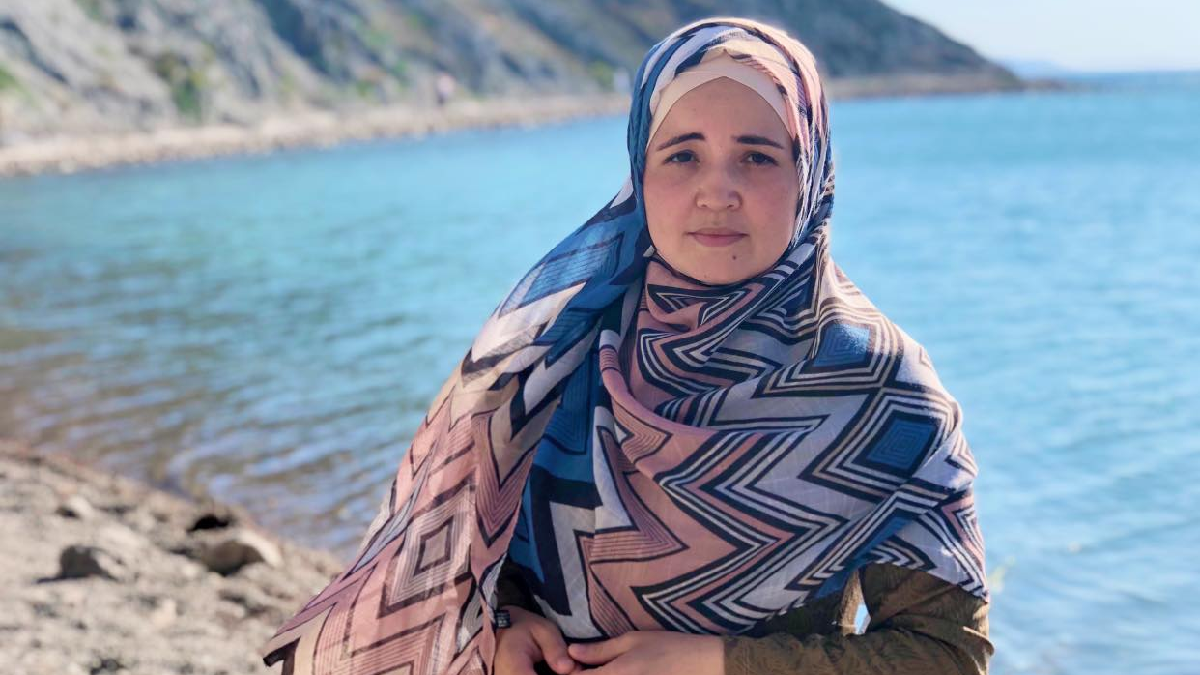
Джерело фото: Лутфіє Зудієва

Підготовка інформаційного матеріалу стала можливою завдяки Програмі «Права людини в дії», яка виконується Українською Гельсінською спілкою з прав людини за підтримки #USAID. Представлені тут погля (1)
ДокументуванняНовини

700 днів повномасштабної війни в Чернігівській області: узагальнення подій

У цій публікації подається узагальнення інформації, зібраної громадською організацією «МАРТ» спільно з громадською спілкою «Освітній дім прав людини в Чернігові», у рамках глобальної ініціативи «Трибунал для путіна» про ймовірно скоєні міжнародні злочини за 700 днів повномасштабної російсько-української війни на території Чернігівської області.

Було задокументовано 4020 епізодів за весь період і 14 епізодів безпосередньо за січень 2024 р.

Інформація в цій публікації є приблизною, спирається на зібрані нами дані та потребує уточнення.

1. Інформація про жертви серед цивільного населення

За досліджуваний період, в Чернігівській області нами було зафіксовано загалом 635 епізодів, пов’язаних із людськими втратами чи порушенням прав серед цивільного населення.

Тип втрати чи порушення правПостраждалих
Загибель людини541
Поранення людини565
Порушення прав615
Зникнення людини46
Усього1767

1.1. Інформація про загиблих та поранених серед цивільного населення

За даними, які задокументовані в нашій базі, за досліджуваний період в Чернігівській області внаслідок ракетних, мінометних та артилерійських обстрілів, а також на вибухових пристроях різного характеру загинуло щонайменше 541 людина та було поранено щонайменше 565 осіб.

Близько 15:00 години 30 грудня росіяни обстріляли Семенівку, що в Новгород-Сіверському районі. Загинув 32-річний місцевий житель. Пошкоджено понад 30 будинків та інша цивільна інфраструктура. За інформацією поліції Чернігівської області, російська армія завдала близько 20 ударів по центру Семенівки з реактивних систем залпового вогню «Град».

Фото: поліція Чернігівської області

10 січня близько 5 ранку у Семенівській громаді російська диверсійно-розвідувальна група розстріляла авто із цивільним чоловіком. Загиблий чоловік був 1961 року народження. Він працював водієм шкільного автобуса у селі Костобобрів.

2. Інформація про житлові будинки та об’єкти цивільної інфраструктури, що зазнали пошкоджень унаслідок бойових дій

За даними, які вже задокументовані в нашій базі, у Чернігівській області за досліджуваний період унаслідок переважно ракетних ударів було зруйновано/пошкоджено щонайменше 5452 об’єкти цивільної інфраструктури, серед яких:

Вид об’єктівКількість
Об’єкти підприємницької діяльності та комерційно-виробничого призначення278
Будівлі житлово-побутового призначення3879
Будівлі лікувально-оздоровчого закладу40
Об’єкти культурно-розважального закладу20
Будівлі освітньо-виховного закладу105
Будівля державної установи44
Об’єкти транспортної інфраструктури29
Господарчі угіддя, ліси405
Будівлі культового призначення23
Об’єкти інфраструктури життєзабезпечення73
Історичні пам’ятки23
Мости19
Транспортні засоби (автомобіль, судно)513
Гуманітарний конвой1
Загалом об’єктів5452

Ось деякі з цих випадків за останній місяць: 

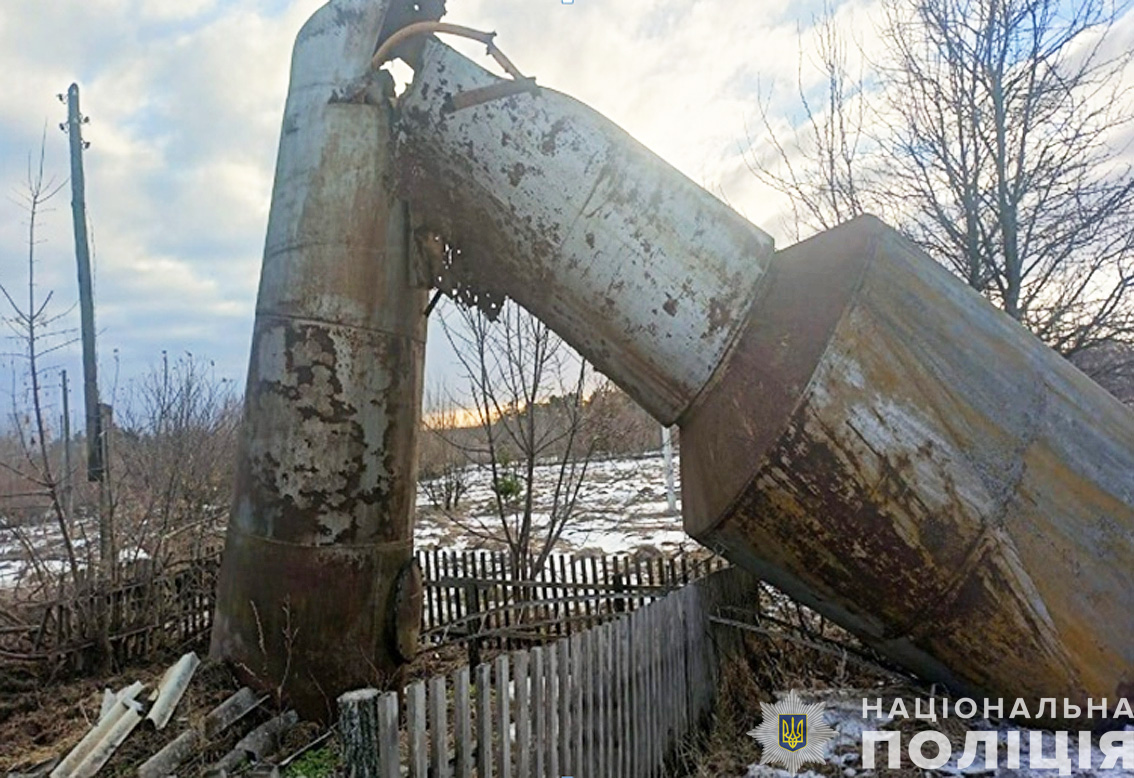
27.12.2023 року ворожа армія прицільно атакувала обладнання РЕМ та водонапірну башту в одному з прикордонних сіл Сновської громади. Внаслідок обстрілу без електропостачання залишилось дев’ять населених пунктів.

Фото: поліція Чернігівської області

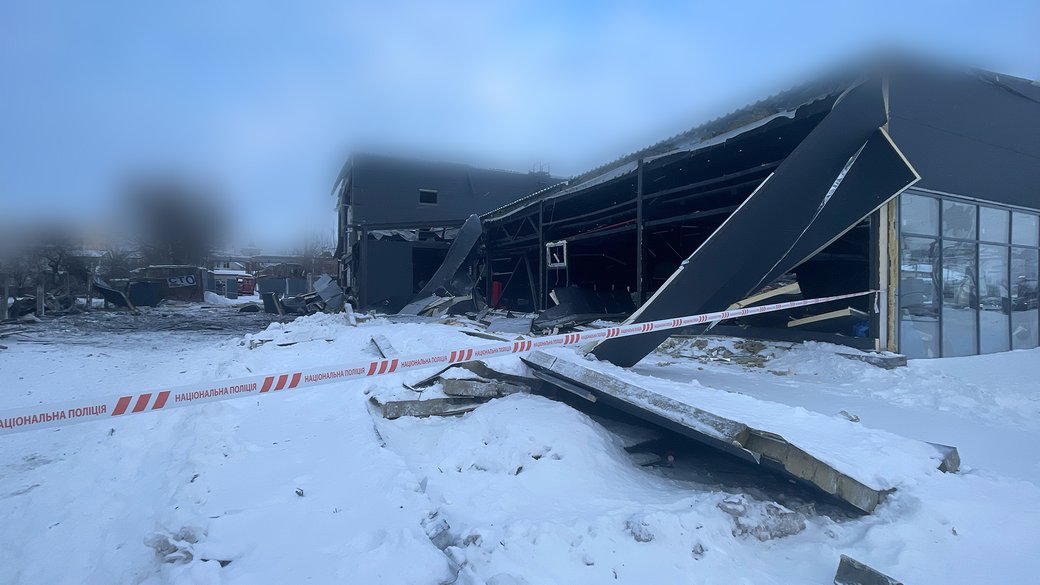
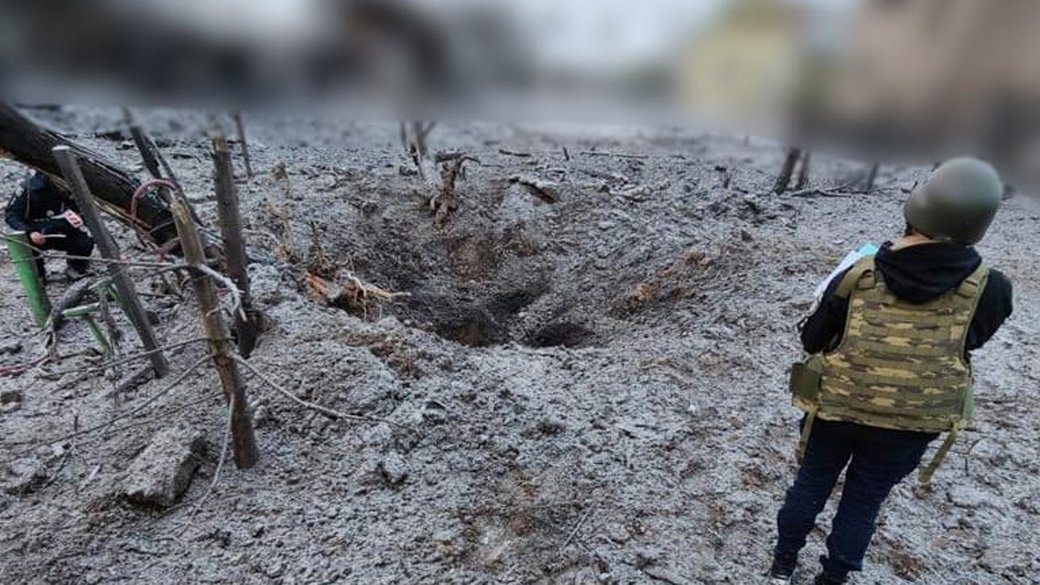
13.01.2024 року внаслідок ракетного удару по мікрорайону Бобровиця в м. Чернігові пошкоджено багатоквартирний будинок, у якому пошкоджено 20 квартир — вибиті балконні рами та вікна; 28 приватних житлових будинків, а також 4 магазини.

Фото: поліція Чернігівської області

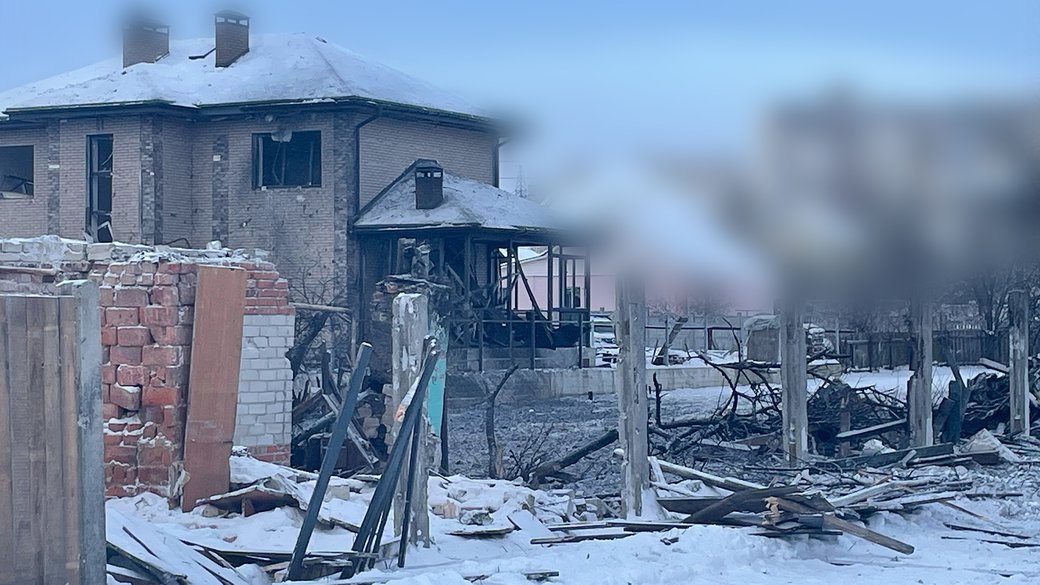
У період із 10.01.2024 року по 16.01.2024 року росіяни вкотре обстріляли мирне населення на прикордонні Чернігівської області. Внаслідок обстрілу 72-річна мешканка одного з прикордонних сіл Семенівської громади Новгород-Сіверського району залишилася без даху над головою. За словами жінки, під час російського обстрілу вона була в будинку і почула вибух. Внаслідок обстрілу у будинку вибило вікна, пошкодило дах, осколками посікло стіни. Оселя стала геть непридатною для проживання самотньої літньої жінки.

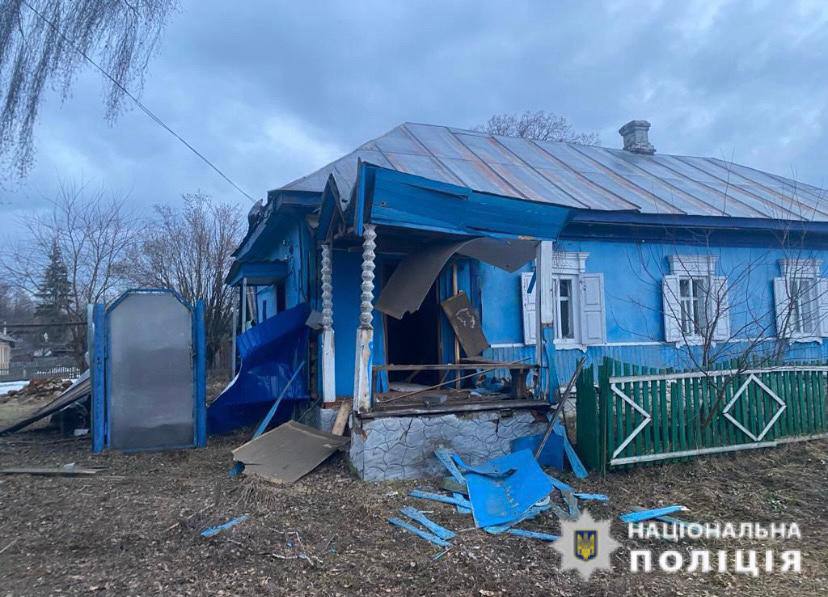
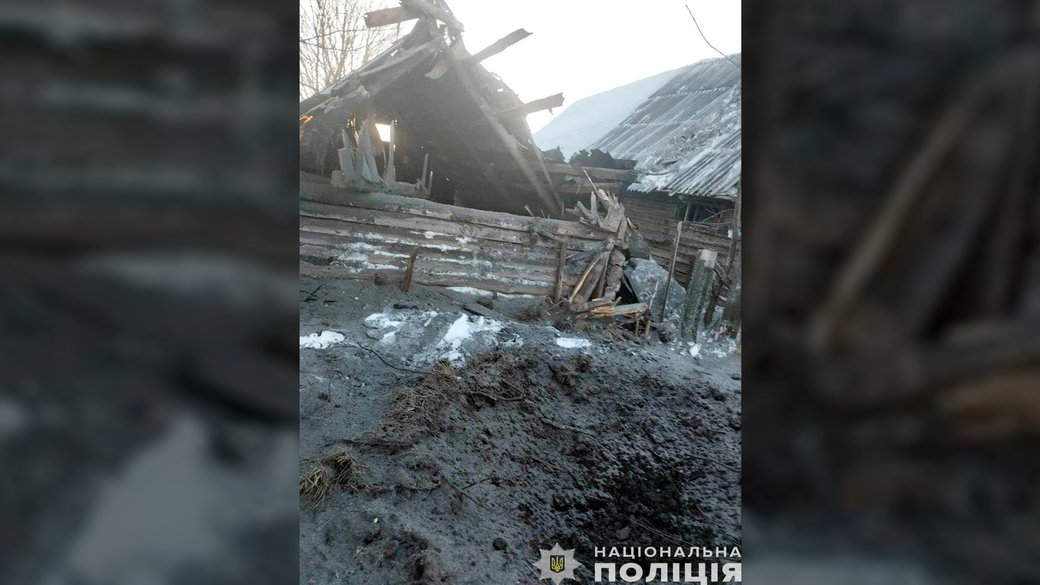
18.01.2024 року внаслідок російського обстрілу с. Залізний Міст, Новгород-Сіверського району пошкоджені житловий будинок та господарські споруди.

Фото: поліція Чернігівської області

Близько 15:00 години 30 грудня 2023р. росіяни обстріляли Семенівку, що в Новгород-Сіверському районі. Внаслідок обстрілу пошкоджено понад 30 будинків та інша цивільна інфраструктура. За інформацією поліції Чернігівської області, російська армія завдала близько 20 ударів по центру Семенівки з реактивних систем залпового вогню “Град”.

10 січня 2024 р. близько 5 ранку у Семенівській громаді російська диверсійно-розвідувальна група розстріляла авто із цивільним чоловіком.

3. Інформація про типи подій, які були задокументовані за досліджуваний період

За даними, які вже задокументовані в нашій базі, за досліджуваний період у Чернігівській області сталися такі події:

ПодіяЕпізодів
Арт. обстріл (бомбардування)2996
Авіаудар291
Ракетний удар60
Касетні засоби ураження15
Обстріл зі стрілецької зброї113
Ушкодження транспортним засобом26
Вибуховий пристрій99
Катування (тортури), нелюдське поводження57
Незаконне позбавлення волі79
Привласнення майна цивільних осіб114
Напад на склад гуманітарної допомоги, гуманітарний конвой, гуманітарну місію чи коридор5
Використання цивільного населення як щита32
Взяття заручників5
Захоплення цивільної будівлі27
Інше24

Аналіз зібраної інформації дає підстави стверджувати, що протягом останнього місяця зс рф ведуть щоденні обстріли як прикордонних територій Чернігівської області, так і самого м. Чернігів. Фіксуються постійні проникнення ДРГ, ворог застосовує для обстрлілів артилерію, міномети, РСЗВ, БПЛА, пуски ракет з гелікоптерів, стратегічної авіації, тощо – все це неминуче призводить до руйнування цивільної та критичної інфраструктури життєзабезпеченя, людських втрат серед цивільного населення.

Загалом за останній місяць від ворожих обстрілів пошкоджено (знищено) щонайменьше 63 будинки житлового-побутового призначення, 2 об’єкти інфраструктури життєзабезпечення, 2 автомобілі, 4 об’єкти підприємницької діяльності та комерційно-виробничого призначення. На жаль, двоє людей загинули.

Основне фото: поліція Чернігівської області

Збір інформації триває. Якщо ви можете надати додаткову інформацію, будь ласка, напишіть нам на адресу tribunal_for_putin@helsinki.org.ua.

Аналіз підготував координатор громадської приймальні УГСПЛ в м. Чернігів, що діє на базі ГО «МАРТ», Дмитро Науменко 

Окупація села Левковичі (2)
ДокументуванняНовини

Occupation of Levonky village

Levonky is a small village located in the Chernihiv region, about 25 kilometers from the regional center. About a hundred people live here, and the only one of its kind in Ukraine, the “Regional Center for Social Adaptation,” is located here. It was created mainly for people without a permanent place of residence.

On March 30, 2022, two columns of Russian military vehicles entered the village. On the way, they shot the transformer, immediately cutting off the electricity. After arriving in the village, Russian soldiers selected six local men for work and forced them to saw fallen trees that blocked the bridge over the river. They began conducting searches, trying to find Ukrainian soldiers and those who blocked their path.

“Pray, because your life is over…”

The men sawed the trees and returned. About 20 minutes later, Russian soldiers came back to the houses and took them, leading them to the territory of the Center for Social Adaptation. They took phones from everyone and interrogated them.

The soldiers took the men to the courtyard, made them kneel down, and tied their hands with ropes. They fired shots in different directions, threatening to shoot them. They told one of them, “Pray, because your life is over, we will kill you now, don’t worry—it will be quick.” Then they brought his father and also interrogated and fired shots over his head. Another local resident was beaten, and they threatened to deal with his family.

Later, the Russians took everyone to another room. There was a cage where the men were placed. They had guards and sometimes the commander visited. The men managed to escape only when the Russian military left the village.

Plundering and Destruction

Russian soldiers did not bypass the Center for Social Adaptation and stayed there for a day. They spent the night in a building that the staff used as a warehouse. They stole equipment, mattresses, pillows, dishes, and chairs. They left a mess. Russian soldiers even took things from a second-hand store that were brought here as humanitarian aid. Moreover, they shot two cows from the farm, which were taken care of by the center’s wards.

They looted the houses of local residents, taking whatever they liked. In one cellar, they threw a grenade. Moreover, in the village, Russian soldiers were often seen in a state of drunkenness.


The inscription left by Russian soldiers in the village club: “Forgive us, we came for the Bandera supporters. And there are looters among everyone :)”. Photo provided by witnesses.

Tank with an Explosive Before leaving the village, the wards of the Center were locked in a separate room. Witnesses said that meanwhile, Russian soldiers looted, poured fuel into one of the tanks, set it on fire, and closed the hatch. It burned for about an hour, and then exploded with such force that the tank’s caterpillar flew over the roof, it was found about 150 meters from the explosion site. Another piece of iron buried in the ground damaged the main water pipeline. The utility building collapsed nearby. The tank wheel pierced the trunk of a century-old tree, which fell. Nearby houses were damaged, the ceiling collapsed at the Center for Social Adaptation, windows were smashed, and so on. People managed to get out and put out the fire.

Volunteering

Since the beginning of the full-scale invasion, the wards and employees of the Chernihiv Regional Center for Social Adaptation have been engaged in volunteering. They fed people in Chernihiv who were in bomb shelters with milk from the Levonka farm and other products. They delivered supplies to the blockaded city 25 kilometers away, even during shelling.

Even in just a few days of occupation, local residents were able to experience firsthand what “Russian world” is and how they could help others.


The preparation of informational materials became possible thanks to the Human Rights in Action Program, implemented by the Ukrainian Helsinki Human Rights Union with the support of #USAID. The views and interpretations presented here do not necessarily reflect the views of the US government, USAID, or #UHHRU. The authors and UHHRU are solely responsible for the content of the publication.

Окупація села Левоньки
ДокументуванняНовини

Окупація села Левоньки

Левоньки невеличке село, що знаходиться в Чернігівській області, за 25 кілометрів від обласного центру. Тут проживає близько сотні людей та розташовується єдиний в Україні подібного профілю “Обласний центр соціальної адаптації”. Створений переважно для осіб без постійного місця проживання. 

30 березня 2022 року в село заїхало дві колони російської військової техніки. Дорогою розстріляли трансформатор, одразу зникло світло. Після прибуття на територію села, російські солдати обрали для роботи шістьох місцевих чоловіків та змусили розпилювати повалені дерева, що перекривали міст через річку. Почали проводити обшуки, намагалися знайти українських військових та тих, хто перекрив їм дорогу.

Фото надане свідком

«Молися, бо твоє життя закінчене..»

Чоловіки розпиляли дерева і повернулися. Приблизно через 20 хвилин російські військові знову прийшли до будинків та забрали їх, повели на територію Центру соціальної адаптації. Відібрали у всіх телефони, допитували.

Солдати вивели чоловіків на подвір’я, поставили на коліна та зв’язали руки мотузками. Стріляли в різні боки, погрожували розстрілом. Одному з них сказали: «Молися, бо твоє життя закінчене, ми зараз тебе вб’ємо, не хвилюйся це буде швидко». Потім привели його батька, теж допитували і стріляли над головою. Іншого місцевого жителя побили, погрожували розправитися з його родиною.

Згодом росіяни забрали всіх та повели до іншого приміщення. Там була клітка, куди чоловіків помістили. Приставили охоронця, іноді навідувався командир. Чоловікам вдалося вибратися тільки тоді, коли російські військові покинули село.

Грабували та нищили

Російські солдати не оминули і Центр соціальної адаптації та пробули там одну добу. Ночували у корпусі, який працівники використовували як склад. Викрали техніку, матраци, подушки, посуд та стільці. Залишили безлад. Російські військові забрали навіть речі із секонд-хенду, який сюди привезли як гуманітарну допомогу. Окрім того, розстріляли двох корів із ферми, якою опікувалися підопічні центру.

Грабували будинки місцевих мешканців, забирали все, що сподобалося. В один з погребів кинули гранату. До того ж у селі російських військових часто помічали в стані алкогольного сп’яніння.

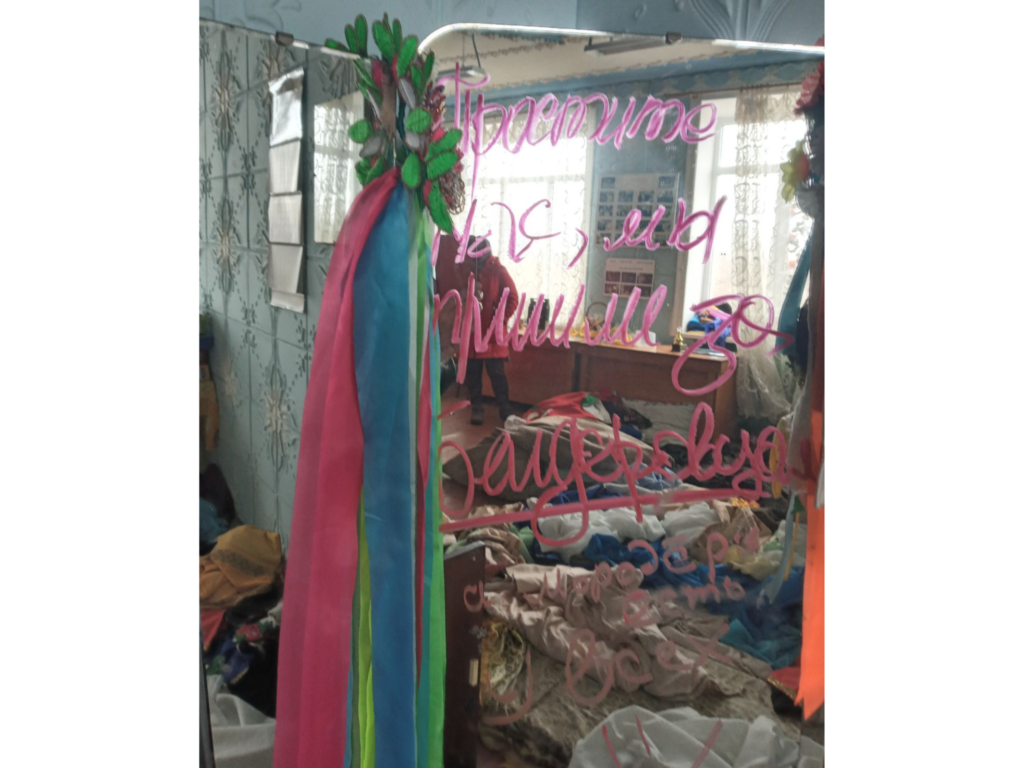
Напис, який залишили російські військові в сільському клубі: “Простите нас, мы пришли за бендеровцами. А мародери есть у всех :)”. Фото надане свідком.

Танк з вибухівкою

Перед тим як покинути село, підопічних Центру замкнули в окремому приміщенні. Свідки розповіли, що тим часом російські військові мародерили, залили в один із танків пальне, підпалили та закрили люк. Він горів близько години, а потім вибухнув з такою силою, що танкова гусениця перелетіла через дах, її знайшли метрів за 150 від місця вибуху. Ще один шмат заліза, закопавшись у землю, пошкодив магістраль водоводу. Господарська будівля поряд звалилася. Танкове колесо пробило стовбур столітнього дерева, воно впало. Поряд пошкоджені будинки, в Центрі соціальної адаптації обвалилася стеля, вибито вікна тощо. Люди вибралися, загасили пожежу.

Волонтерство

Від початку повномасштабного вторгнення підопічні та працівники Чернігівського обласного центру соціальної адаптації займалися волонтерством. Молоком з ферми в Левоньках та іншими продуктами годували людей в Чернігові, які перебували в бомбосховищах. Доставляли під обстрілами в блокадне місто за 25 кілометрів. 

Навіть за декілька днів окупації місцеві жителі встигли добре відчути на собі, що таке “рускій мір” та чим могли допомагали іншим.

Підготовка інформаційного матеріалу стала можливою завдяки Програмі «Права людини в дії», яка виконується Українською Гельсінською спілкою з прав людини за підтримки #USAID. Представлені тут погляди та інтерпретації не обов’язково відображають погляди Уряду США, USAID або #УГСПЛ. Відповідальність за вміст публікації несуть виключно автори та ОДПЛЧ.

Окупація села Левковичі (1)
ДокументуванняНовини

Occupation of the village of Levkovichi

On February 28, 2022, the first column of Russian troops passed through the village of Levkovychi in Chernihiv region, starting an occupation that lasted just over a month. During this period, the Russians brutally killed local residents, detained and tortured them. People also died from shelling and lack of medicine. Houses in the village were damaged and looted.

On January 5, our documentarians visited Levkovychi and recorded evidence of war crimes committed in February-March 2022.

Russian soldiers shot dead four men: Oleksandr Orishko, Oleksandr Derkach, Yaroslav Varava, and Serhiy Nemchenko. Local residents heard gunfire, and later their fellow villagers found them dead. The bodies had numerous gunshot and stab wounds, as well as signs of beating. The men were tortured by Russian soldiers and then killed. The bodies of the deceased were found in the center of the village, right next to the cross. It is known that the men were preparing Molotov cocktails to stop columns of Russian troops, but they had no weapons. Their lives were cut short on the first day of the occupation.

The man who walked from Slavutych to Levkovychi was detained and taken prisoner. The Russians decided to make him a “messenger.” To make him agree, they tortured him, cutting crosses with a knife where tattoos were on his arms and legs. To prevent him from escaping, they went to his parents’ house and took his father hostage. The man was sent to Slavutych to deliver a letter to local authorities. What was written there is unknown, as there was no opportunity to see.

Witnesses who agreed to be interviewed spoke of looting by Russian soldiers. They looted uninhabited houses, and where people lived, they entered and took food, cars, livestock, and even underwear. Shops and the village council were also looted. Local farmers also suffered from abuses by Russian soldiers. Agricultural machinery on a farm in the village was destroyed and shot at. Russian army soldiers used fuel stocks prepared by the farmer for sowing and destroyed grain stocks.

Знищене зерносховище у селі Левковичі

There are many damaged houses in the village, with about 150 of them having damage. They suffered not only from shelling but also from Russian soldiers placing vehicles near houses and firing at Chernihiv. Two people died from shelling. These are Sotnyk Vitaliy and Tovkun Nina. Nina’s son, Oleg Tovkun, was injured and is still undergoing rehabilitation abroad.

The residents of Levkovychi lived in constant fear during the occupation. Civilians were threatened with death, for example, for violating the order not to look towards Russian soldiers or for refusing to accept food under the guise of humanitarian aid. They were forbidden to walk around the village or talk to each other. Living conditions in the occupation were also complicated by the lack of electricity, gas, communication, and especially medicine. In these conditions, six elderly people died in the village.

This continued until April 3, 2022, the day Levkovychi was liberated.


The preparation of this informational material was made possible thanks to the Human Rights in Action Program, implemented by the Ukrainian Helsinki Human Rights Union with the support of #USAID. The views and interpretations presented here do not necessarily reflect the views of the US Government, USAID, or #UHHRU. The authors and Educational Human Rights House – Chernihiv are solely responsible for the content of the publication.


Окупація села Левковичі
ДокументуванняНовини

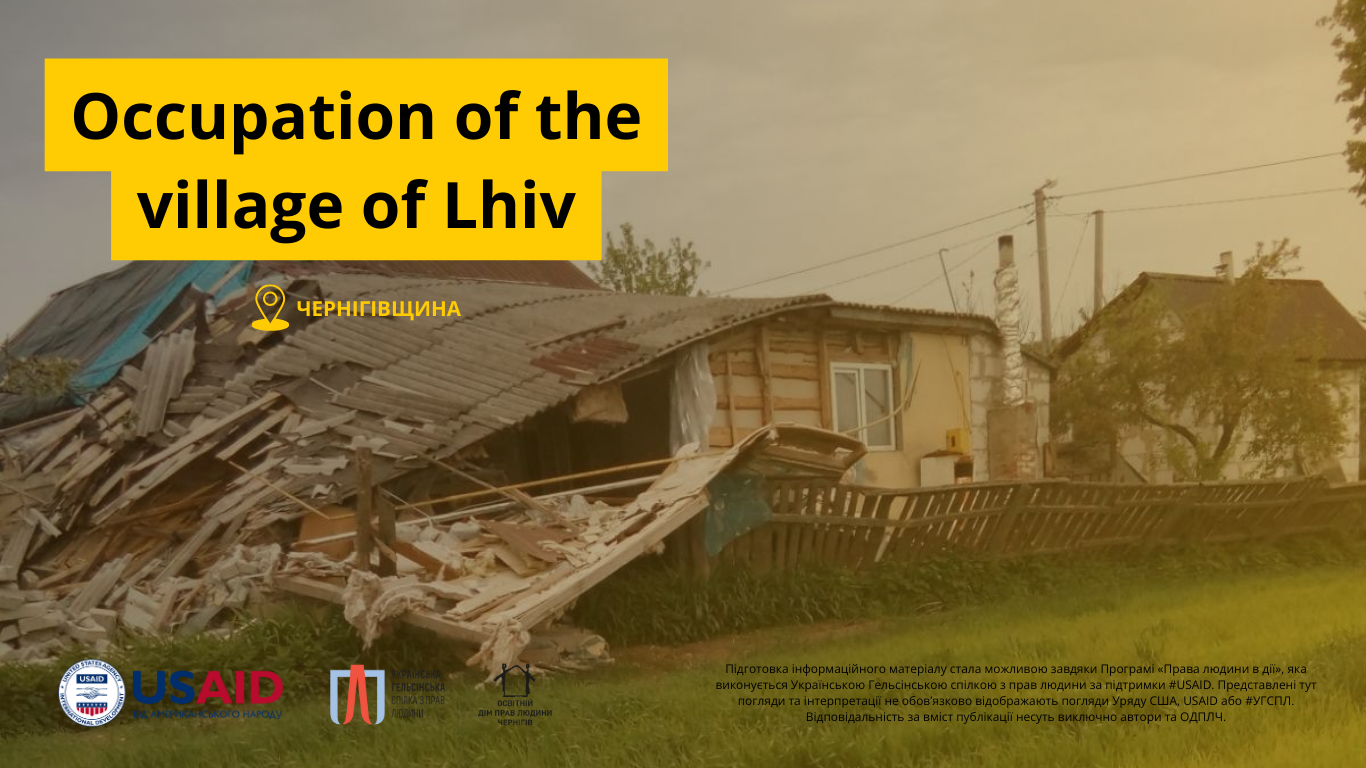
Occupation of the village of Lhiv

The village of Lhiv is located in the Chernihiv region, approximately 50 km from the border with Belarus. In February-March 2022, the settlement was partially occupied. Russian troops entered Ukrainian territory from Belarus. According to local residents, about a thousand soldiers arrived in the village. They placed equipment under buildings and shelled Chernihiv. Trenches were dug throughout the village.

They immediately looted the local store and settled near the forest, in the quarry. Russian military personnel lived in civilian houses, and there were cases where homeowners, even with children, were expelled.

Local residents were detained and constantly checked. Russian soldiers did not allow men to leave the yard, only women and children. They were told that if they saw someone outside twice, they would be shot. They could stop, kneel down, interrogate, or search.

One of the local residents served in the Ukrainian Armed Forces. He was demobilized half a year before the full-scale invasion but had never fought in the East. They took him out onto the street in the middle of the night, beat him, abused him, and tried to extract information. The Russians left him tied up on the street, where he spent four days. He spent the first night even without outerwear. But later, they released him.

The entire family suffered from the rampage of Russian military personnel. Later, journalists managed to identify the commander, Ruslan Kuliyev from Magnitogorsk, who committed war crimes. Also, his subordinate Andriy Chudin, who beat the man. On November 2, the Novozavodsk district court of Chernihiv sentenced these two Russian servicemen in absentia, accused of abusing residents of the occupied village.

They fired at civilian cars. A couple from Kuvychi was driving from Kuvychi to Chernihiv in a car with white flags. The man needed hemodialysis, so the family tried to reach the hospital. Russian troops shelled their car with the BM-27 Uragan MLRS. As a result of the shelling, the car caught fire, the man died, and the woman was injured. Russian soldiers put her in an armored personnel carrier and took her to the village of Luhiv, which was already under their occupation at that time. A local veterinarian and hairdresser removed the bullet, performed bandages, and saved the wounded woman.

During the occupation, there was no electricity, gas, or water in the village. Locals cooked food in ovens, cauldrons, or on the street. There was no communication either. Houses and cars in the village were destroyed and burned.

Before leaving, Russian troops robbed houses and took everything they found valuable, even domestic animals or poultry. In the morning of April 1, 2022, they left the village.


The preparation of this informational material was made possible by the Human Rights in Action Program, implemented by the Ukrainian Helsinki Human Rights Union with the support of #USAID. The views and interpretations presented here do not necessarily reflect the views of the US Government, USAID, or #UHHRU. The authors and UHHRU are solely responsible for the content of the publication.

Frame 308
ДокументуванняНовини

Voices from liberated Kherson region: civilian captives, torture chambers in schools and Russian marauders

On March 31, 2022, 42-year-old accountant Tetiana Veresyuk from Lyubymivka School, along with her nephew, fell into captivity. After a 9-hour interrogation, they were released with the expectation that they would be shot at the first checkpoint…

This is the story of a 7-month occupation of the village of Lyubymivka. It’s about how Russian military forces raided, looted people, turned schools into torture chambers, and warehouses for looted goods and ammunition. And despite the ordeal, Ukrainian teachers continue to educate children not only from areas under control but also from the occupied territories of Kherson region.

The text is based on documented testimonies from Lyubymivka school employees – accountant Tetiana Veresyuk and director Aliona Gergel for the project of the Civil Society “Educational Human Rights House – Chernihiv”. With the financial support of the Czech organization People in Need, within the SOS Ukraine initiative.

“February 24 came as a shock to us. But it was the same shock as in 2014”

The village of Lyubymivka is located in the Beryslav district of Kherson region. Only 25 km away from the front line across the Dnipro River (as of January 2024). When Russian troops arrived here in March 2022, they thought it was a city because of how well-maintained and modern it was.

“Of course, February 24 was a shock to us. But it was the same shock as in 2014, when Donetsk and Luhansk were ‘burning.’ We understood: something terrible was happening. But we fully realized and felt it after March 10, when the occupiers entered our village,” begins Tetiana Veresyuk, the accountant of the local school.

Before the war, 167 children from surrounding villages attended Lyubymivka’s comprehensive school. They traveled to school by the school bus.

On the morning of February 24, the school’s director, Aliona Gergel, called an acquaintance who was a policeman to understand how serious the military situation was in the region. Upon hearing that it was very serious, they decided to switch to online learning.

“Only technical staff and teachers came to school. We prepared shelters so that people from the village could hide there from shelling. We have a large basement that runs under the entire building. We stocked up on water, arranged beds for the children. Later, more than a hundred villagers of all ages took shelter here,” says the school principal, who lives in the neighboring village of Trudoliubivka.

The day of the occupation for Lyubymivka started the same as before. But everything changed after 3 p.m., when Russian military vehicles passed through the edge of the village…

“Occupiers shelled the village and blamed it on the Ukrainian Armed Forces”

On March 10, Russian tanks, APCs, and other equipment stayed overnight behind the village. The next morning, the occupiers shelled Lyubymivka for the first time. Then they entered the village and told the locals that it was done by the Ukrainian Armed Forces.

“Later, we saw how the Russians repeatedly drove out of the village, deployed tanks, mortars, and fired at Lyubymivka. And then they blamed our people for these shelling incidents. There are many witnesses to this,” says Tetiana Veresyuk.

From March 11 to March 14, villagers were forbidden from leaving their yards. Most likely, during those days, the main enemy forces and equipment arrived in Lyubymivka. Then, for three days, people were given a ‘green corridor.’ They were only allowed to go towards the occupied coastal villages, Kherson, and Crimea. Those who dared to go to the free Novovorontsovka were threatened with being shot in the back. Then, out of 1,500 people in the village, only 375 remained. Among those who left was Tetiana Veresyuk. With her family, they settled in Mykhailivka, which was under ‘quiet’ occupation, 37 km away from the woman’s home.

In Lyubymivka, the occupiers initially settled in farm buildings: workshops, pigsties, and machinery sheds. At first, they only looted the destroyed houses left by the owners. And later, says Tetiana, they came up with a new tactic: to shoot at wealthy estates, thus forcing people to request evacuation. After the departure of the owners, these houses were also looted.

“During the 7 months of occupation, there were 4–5 rotations of Russians in the village. It looked like raids by robbers. After the third wave, there were no valuable items left in the village. Once, people heard one occupant complaining to another: he promised his wife to bring a freezer, but there was no such thing in the village anymore. He was very upset about it,” recalls Tetiana.

Due to shelling in Lyubymivka, 10 people of different ages died. Eight of them were buried in their own yards because the occupiers only allowed two hours for this. According to Tetiana, there was no transportation for the people anymore. Therefore, there was not enough time to transport and bury the deceased.

“In captivity, we were constantly interrogated about how we prepared for the war”

Russian soldiers took civilians, both men and women, from Lyubymivka and surrounding villages as prisoners. Some were held captive for months, others for just a few hours. But the most brutal were the Russian National Guard troops.

“Many so-called DPR members were stationed at checkpoints and in villages. Some of them warned us: the Russian National Guard would raid, hide women, girls, and young men… I know of six people from Lyubymivka who were taken captive. In our school, the captives were usually held for up to two days, then released or transported to the school in the village of Bilyaivka. There was a real torture chamber,” shares Tetiana Veresyuk.

From March 31, 2022, the occupiers were supposed to close off Lyubymivka for entry and exit. To get their belongings, Tetiana and her husband’s nephew went home. And on their way to Mykhailivka, at the Osokorivsky checkpoint, Russian soldiers took them captive. It happened around 11 o’clock.

They took away people’s documents, phones, blindfolded them, put them in an APC, and drove them somewhere. Since Tetiana knew the local roads, she guessed it was the Khreshchenivska school. People were kept there until 8 p.m.

“In captivity, we were constantly interrogated about how we prepared for the war. The commander of several of our villages, ‘Vostok’, was particularly meticulous. He called himself either Serhiy Volodymyrovych or Volodymyr Serhiyovych. He was from Donetsk, he knew Ukrainian. He asked about ATO participants, the Armed Forces, families of soldiers who went to war. We said we didn’t know anything because they themselves banned movement around the village… In general, Russian soldiers constantly said terrible things to us. They were awful words, they poured out hatred… But I still don’t understand what it was caused by,” reflects Tetiana.

The woman and her relative were lucky: despite strong psychological pressure, they were not physically tortured. But there were people in the community who suffered torture. Two boys from the neighboring Trudolyubivka were in captivity twice. They didn’t share details with the villagers, just said that ‘it was everything there.’ After the second time, one of the boys committed suicide.

They sent us home with the expectation that we would be shot at the first checkpoint

At 8 p.m. on March 31, Tetiana and her relative were taken somewhere again. After removing the blindfolds, they saw the same Osokorivsky checkpoint, their car. The curfew began, during which movement was prohibited. But the captives were ordered to go home. They were not given back their documents and phones; they could retrieve them only in two days. They weren’t even issued a pass, as was usually done in such situations. They simply wished them, “drive quietly.” But to get to Mykhailivka, Tetiana and her relative had to pass three enemy checkpoints.

“At the first one, near Shevchenkivka, a young soldier was very surprised that we had no passes. And the senior officer nearby said, ‘Don’t you understand why they let them go? They sent them home with the expectation that they would be shot at the first checkpoint because they’re traveling during curfew without anything.’ We persuaded those soldiers to let us pass. We also passed the second checkpoint, near the village of Zolota Balka. There we were warned to drive slowly because near Mykhailivka, there is a soldier who ‘loses control,’ he shoots at people,” recalls Tetiana with concern.

And indeed, they were almost killed there. People barely managed to get out of the car just before reaching the checkpoint. The crazed occupant shouted that they were traveling during curfew, that he would kill them. Then the chief of that post saved Tetiana and her relative. After arguing with the crazed comrade, he sat in the car with the people and escorted them to the turn to Mykhailivka…

Recovering from what they experienced, Tetiana Veresyuk did not even stop working during the occupation. She says she searched for the internet: sometimes it caught near the Dnipro, sometimes in the attic, and even in straw bales. She managed her Lyubymivka school, as well as another one in a neighboring village and Mykhailivka because the accountants couldn’t work there. When she moved to Kryvyi Rih, she left only her Lyubymivka school behind,” says the accountant.

From a top-rated school, the occupiers made a headquarters, ammunition depots, and storages for loot.

The Lyubymivka school was built in 1973. According to the rankings, it was the second-best in the district. Thanks to participation in the New Ukrainian School program, in recent years, classrooms have been modernized, equipment has been purchased. In particular, chemistry, mathematics, and biology classrooms were updated. They acquired 5 multimedia boards, laptops, printers, laminators, televisions, a 3-D printer, and set up an inclusive room… The school created a modern space where children felt comfortable learning and spending time.

But at the end of April 2022, comfort came to an end: the occupiers burst into the school. They turned the modern educational institution into a headquarters, ammunition depots, and storages for looted goods, a temporary prison for civilian captives. And they expelled the locals from the basement and hid there themselves. To have quick access to shelter, they tore up the floor on the first floor. A sniper was constantly on duty on the roof, shooting at the legs of those who approached the school.

The school’s windows were barricaded with sandbags filled right in the courtyard. In the principal’s office, they set up a toilet: they tore off the boards and used the hole as an outhouse. The biology classroom was used by the Russian military as a firing range.

The school was shelled three times. Two were in June, hitting the gymnasium and the dining hall. The last hit was on September 23, 2022, causing the most damage.

“Shelling was the agony of the Russians. They often went out of the village and fired at it to discredit the Ukrainian Armed Forces. And these were the last days before liberation… When the teachers managed to enter the school, they were shocked. There were a lot of shell casings lying around, the Russians left banners. Ammo crates were on the first floor, in the workshops. They looted everything: equipment, even took the carpentry machines from the workshop. In place of the TVs, we saw inscriptions: ‘There was a TV here.’ There was a stench everywhere. Only one printer remained from the equipment, but they soiled it too: they left their excrement there…” – says director Aliona Hergel with disgust.

Even children from the occupied territories are studying

After the liberation of Lyubymivka, education resumed remotely. At the beginning of the 2022 academic year, 232 children received education in the institution, with 82 students joining from the occupied territories.

“On the left bank, children are forced to attend Russian schools, but they study additionally with us: they complete tasks and send them in. Sometimes six of them join from one gadget. These gatherings were noticed by Russian special services, so it became more difficult for the children to join. But many of these students are still with us,” says the school’s director.

Currently, people are gradually returning to Lyubymivka and neighboring villages. At the beginning of the 2023 academic year, 185 students attended the school. However, there are still problems with gadgets and stable internet connection.

Physical restoration of the school building is not yet being discussed. According to the director, the community does not have the funds for this. Therefore, both children and staff work remotely.

The collective was further united by the ordeal. Currently, Tetiana and Aliona, along with their families, have returned to their native villages. People live in modular houses, as their homes are destroyed. Over the 7 months of occupation, the occupiers destroyed 80% of the village. But people don’t want to go anywhere because here, in the steppe, is their native land…


Prepared by Nataliia Naidiuk.